
Start with the footprint, not the style name
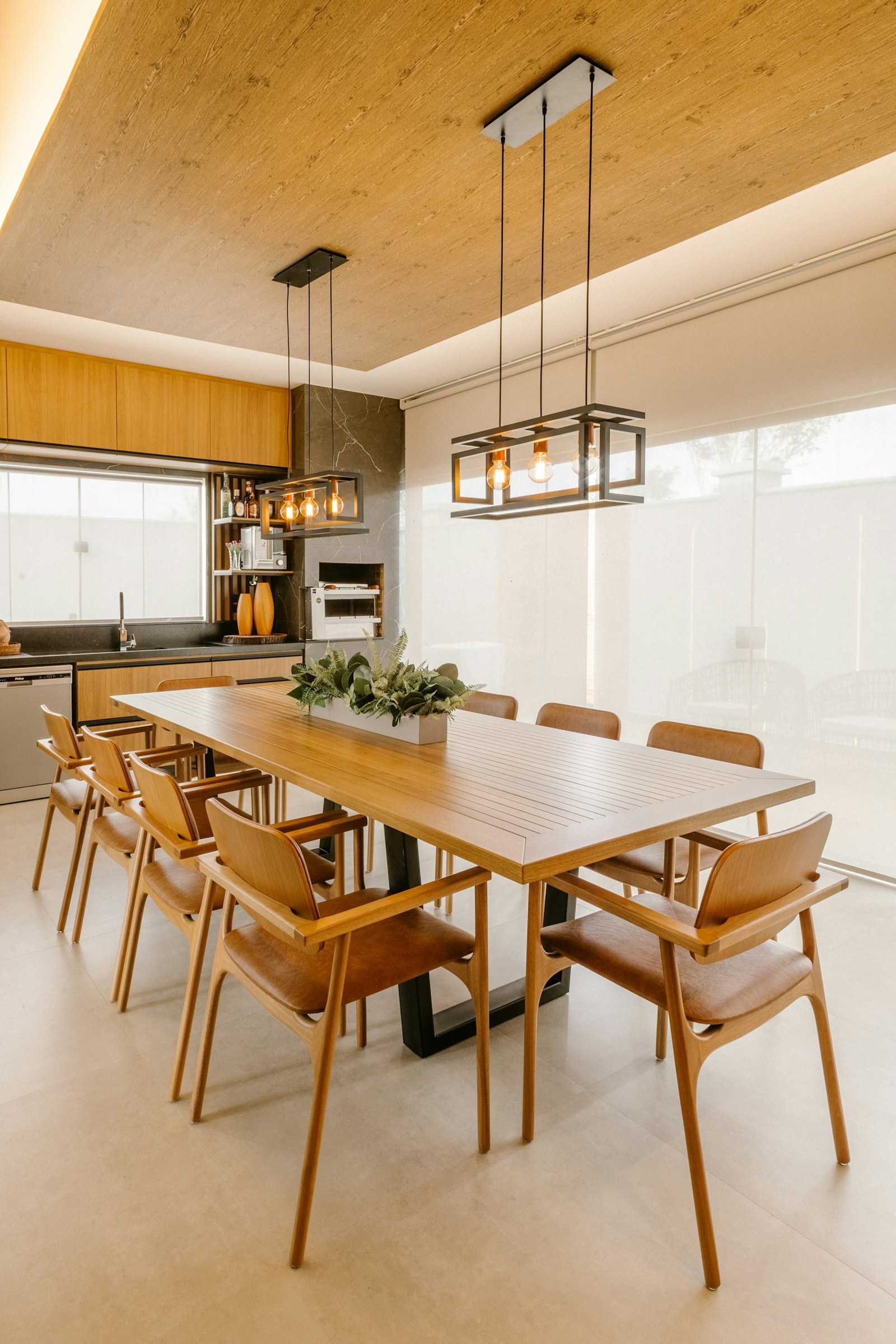
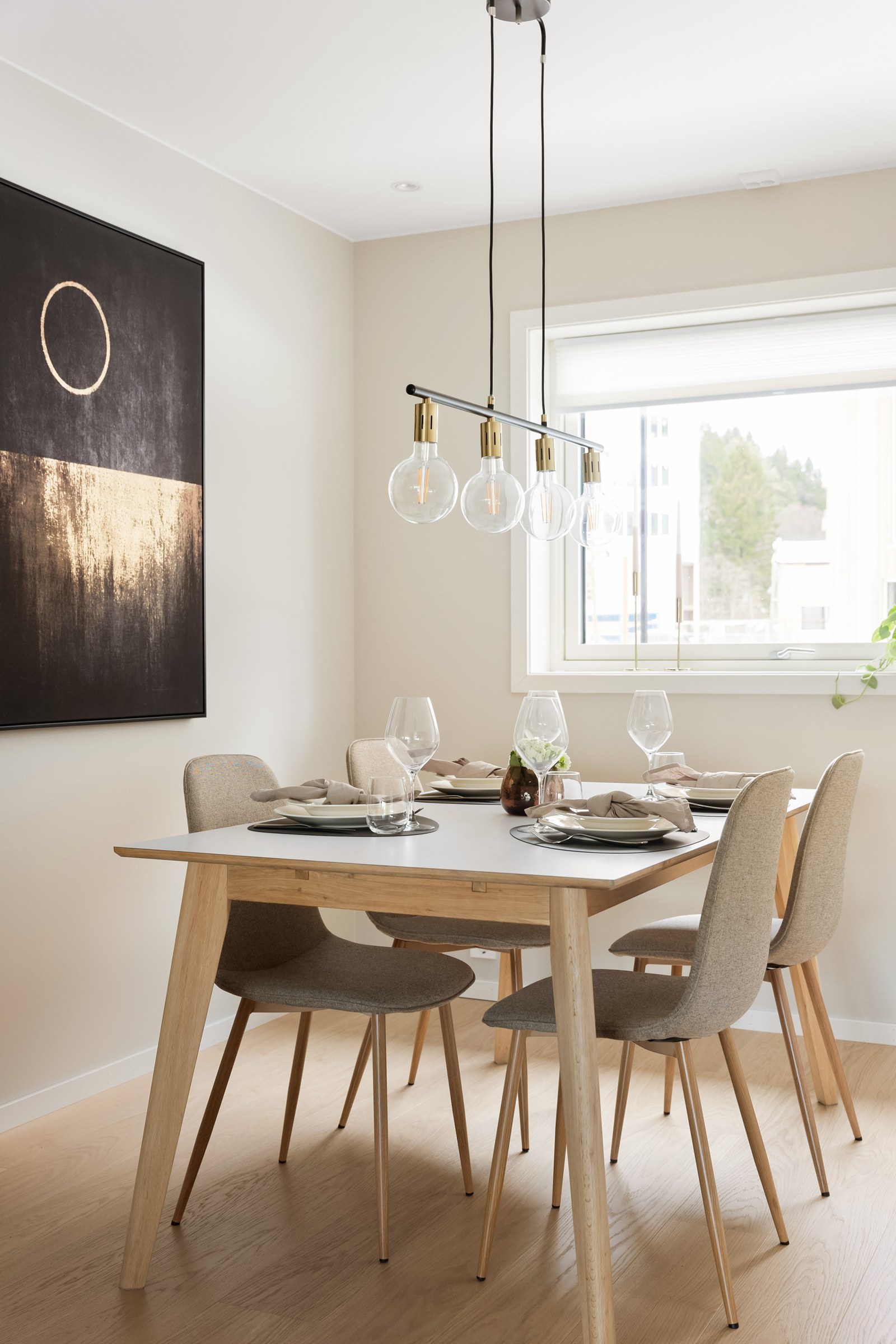
A chair can look compact pushed in and claim the entire walkway once somebody pulls it out. The pale chairs in this narrow dining zone leave useful patches of floor visible around the table; their delicate wooden legs make the setting feel less crowded. That appearance is a reason to investigate their proportions, not proof that any similar chair will fit your room.
Measure the tabletop height and the clearance below its apron separately. Standard dining tables are commonly around 30 inches (76 cm) high and seats often around 17–19 inches (43–48 cm) high. About 10–12 inches (25–30 cm) from seat to tabletop is a reasonable first comparison, but a thick apron, cushion compression, and the diner’s body change the usable space. Test arm height as well if you are considering armchairs.
For seating capacity, start with roughly 24 inches (61 cm) of table edge per diner, including elbow room, then check the space between the actual table legs. Ashley also suggests around 24 inches (61 cm) to pull out a chair and about 36 inches (91 cm) where people need to pass. These are planning guides, not fixed standards. Tape the chair’s full width and pulled-out position on your floor, then walk the route as though somebody were seated.
Sizing references: Pottery Barn and Ashley.
Let a curved wooden chair soften a heavy table
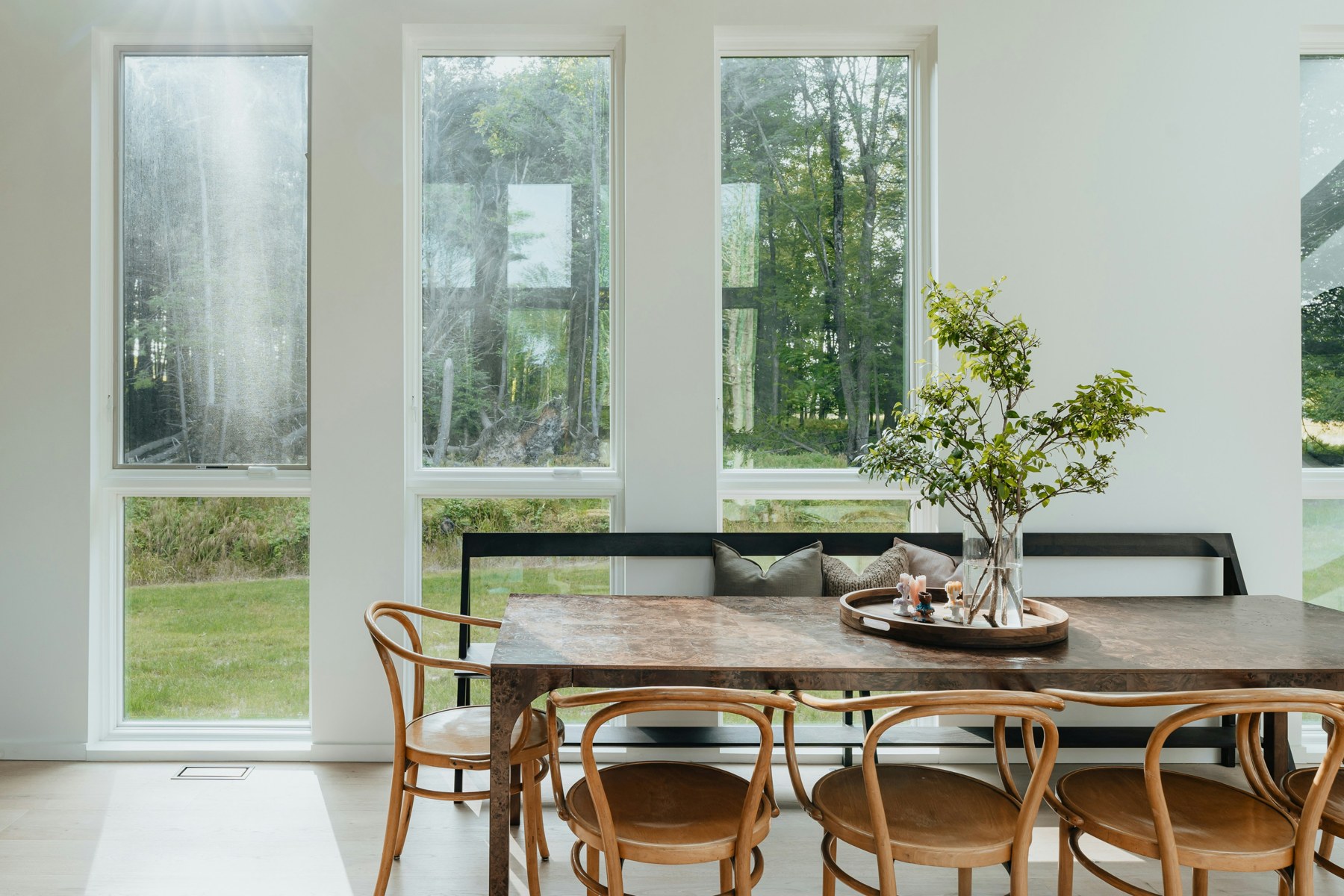
Here, honey-colored wooden chairs with curved backs meet a much darker, substantial tabletop. Their rounded backs and narrow rails interrupt the table’s straight, heavy outline without introducing an unrelated material. The contrast comes from shape and tone together.
This is a useful pairing for a thick wood table or a room where the floor already brings plenty of warm color. Instead of looking for an almost-matching furniture set, put two contrasting back profiles beside the table: a straight, square chair and a rounded one. Stand back and see which provides the outline the room needs.
A lighter chair makes the dark tabletop more distinct; darker chairs would repeat its weight. Neither option depends on identifying a specific wood species from a photo. Check the actual finish beside your table in daylight, and feel the back rail before choosing a rounded-back chair for long dinners.
Use black open-back chairs for definition
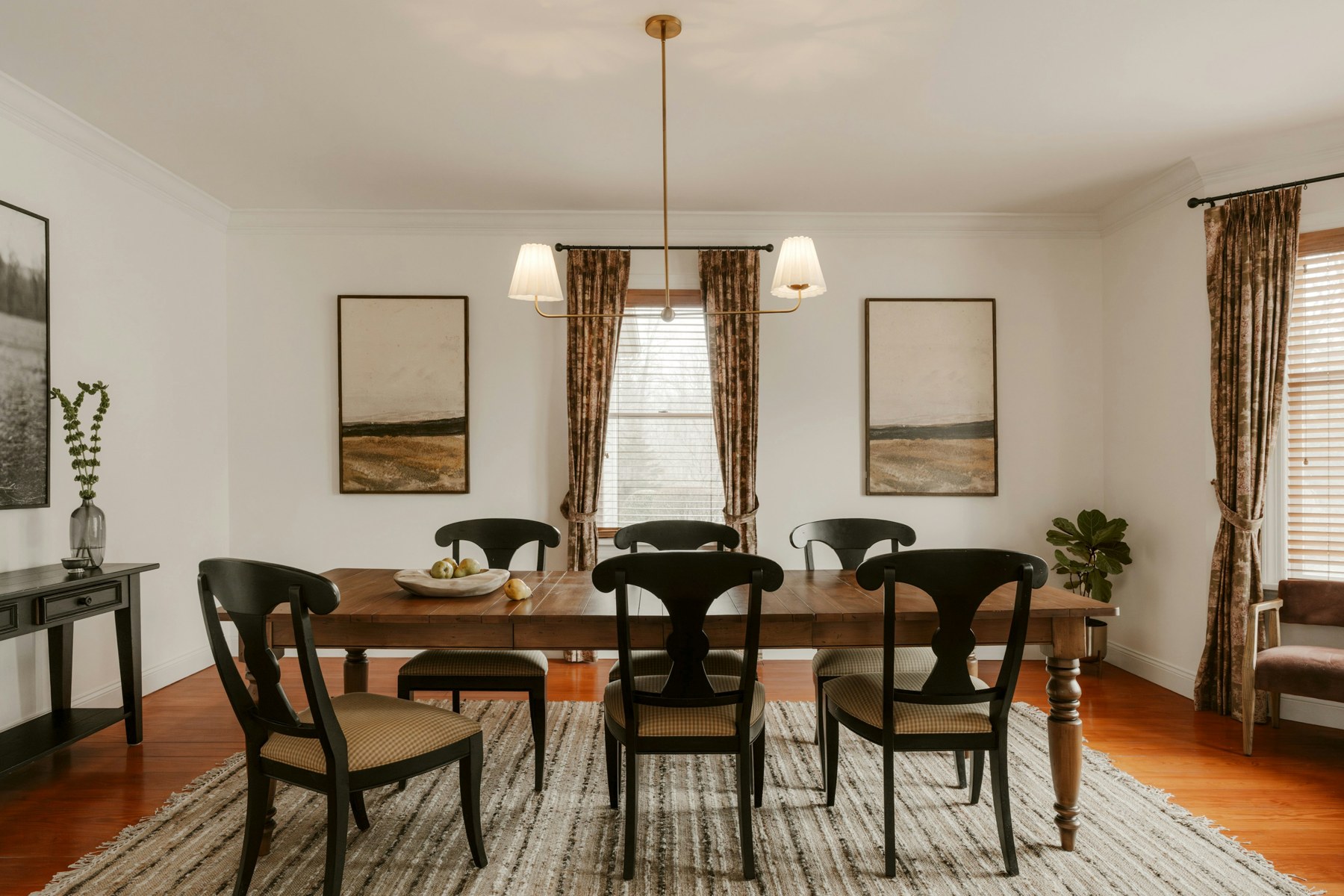
The black dining chairs in this traditional room have cutout backs—not the dense shape of a full upholstered panel. Their dark top rails and legs draw a repeated outline around the warm table, patterned rug, and wood floor. The dark silhouettes keep those brown surfaces from merging together.
For a similar effect, let the chairs supply the most consistent dark accent. A crowded tabletop or several competing patterns could obscure the back shapes that make the grouping work. Check the view from the doorway: most of the day, that is how the chairs will be seen.
A hard seat and an upright rail can feel very different from a padded chair. Sit long enough to judge the back contact and seat edge. If you want mixed chairs, a matching seat height and a shared black finish may link contrasting shapes; the pictured room itself is a matching group, not evidence of a mismatched installation.
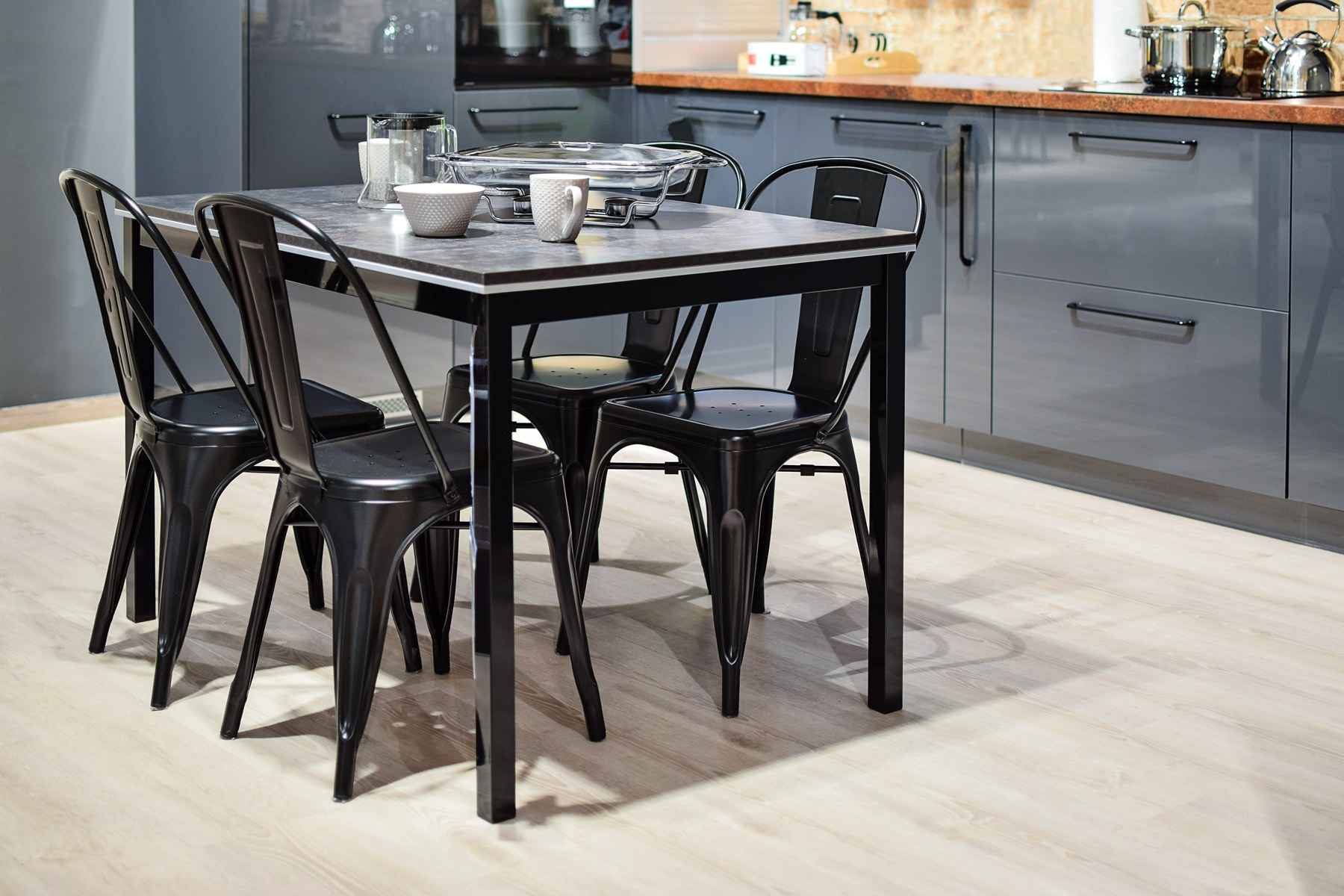
Borrow the kitchen’s dark accents for metal chairs
Black metal chairs beside the slate-blue kitchen repeat the room’s darker hardware and cabinetry accents. Their open frames create a crisp outline around the small table, but they leave glimpses of the pale floor and kitchen behind.
In an open-plan room, matching every surface is unnecessary. Choose one existing accent—the cabinet hardware, pendant shade, or a dark appliance—and repeat it in the chair frame. Metal is especially effective when the room has several softer wood and textile finishes that need a sharper line.
Check more than the finish: the rim of the seat, the angle of the back, the chair’s weight when you pull it out, and whether its feet suit your flooring. A slim frame does not establish comfort, stability, or scratch resistance. Move a sample chair on the actual floor if you can. Test the path to the refrigerator and dishwasher with the chair pulled out. If you want more texture than the metal chairs pictured here, a woven chair back is a possible alternative—repeating the same dark frame while changing the seat/back surface. Confirm the actual material and its care instructions rather than assuming it is cane.
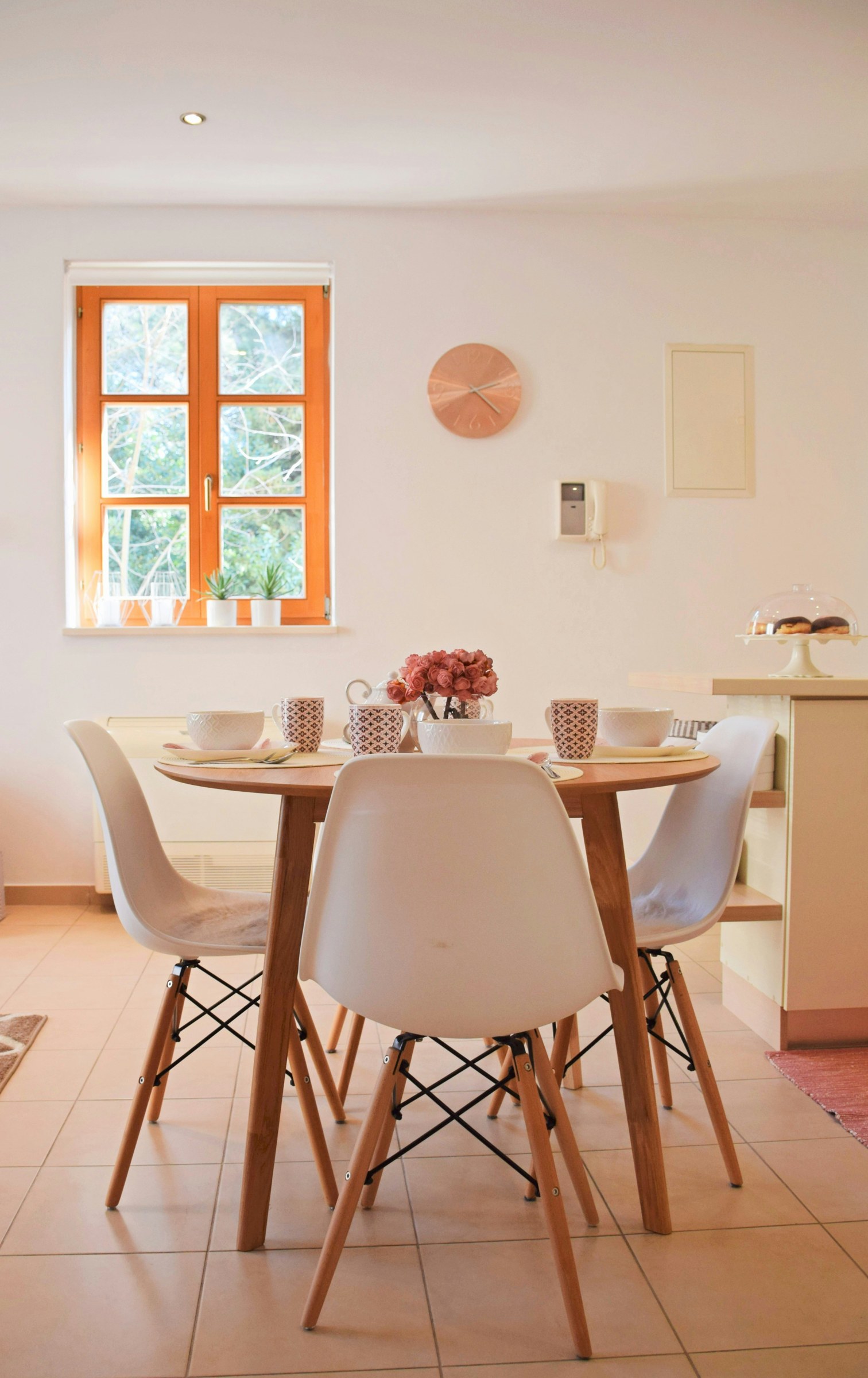
Give a small round nook a light shell chair
A little round table and pale shell-shaped chairs create an uncomplicated breakfast corner. White curved seats and narrow wooden legs make the furniture easy to read against the light background, while the rounded forms echo the table edge.
For a compact eating area, choose the chair that uses space efficiently rather than the smallest one in the catalog. Seat width, seat depth, and the way the legs spread at floor level matter more than a marketing word like “petite.” An armless shape can also be easier to position around a small circumference.
Set out every chair you intend to use daily, then turn one outward as if someone is getting up. If the dining nook meets a kitchen path, that occupied position—not the polished tucked-in photo—should decide the seating count.
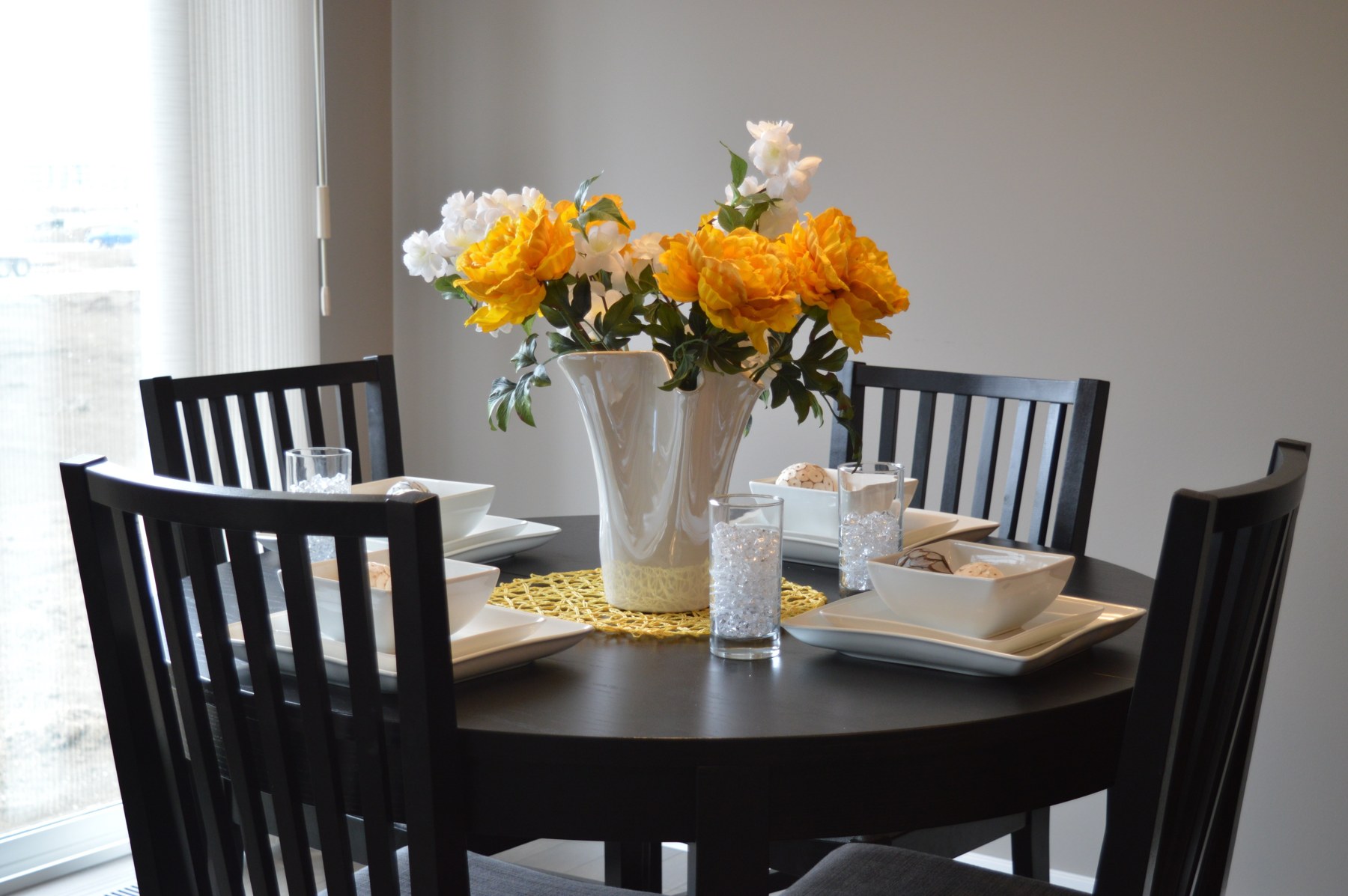
Repeat one strong chair back around a round table
The other round-table example makes almost the opposite visual choice. Black slat backs repeat at the same height around a dark tabletop. Because each chair faces a different direction, the identical top rails and vertical openings give the grouping a steady pattern.
Choose repetition when you want the dining set to feel deliberate from every angle. The pale shell chairs in the preceding, entirely separate room make a softer, lighter pattern; these black backs give a stronger perimeter. The choice depends on the size of your room and how much visual emphasis you want around the table.
Round tables can bring chair legs and table bases into close contact. Test how far each chair rotates and pulls out without catching the pedestal or another seat. A uniform chair back may solve the visual problem while the base still creates a practical one.
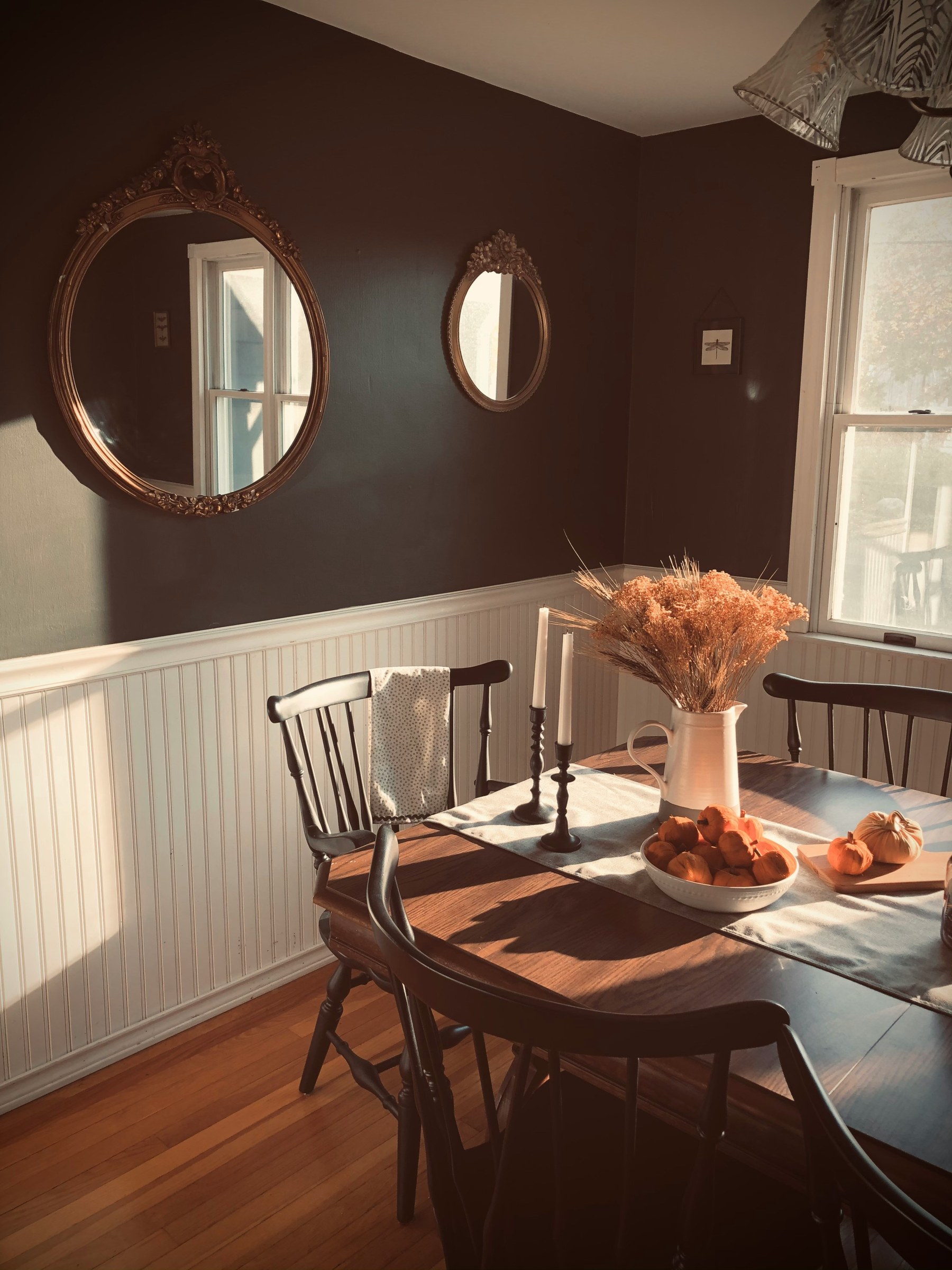
Use pale paneling to separate dark chairs from a dark wall
In this moody nook, the chairs are dark, the wall above is dark, and the wood table is warm. The white paneling is the important divider: it provides a pale strip behind the chair backs, so their shape does not disappear into the brown wall.
If you like a dark dining room, decide what each chair will be seen against once it is pushed in. A pale lower wall, a brighter tabletop, or a visibly different wood tone can create that edge. Dark chairs against an equally dark uninterrupted backdrop may lose their outline, which may be intentional but should be a choice.
Look at the finish and fabric in the evening light you actually use. A chair can be sharply defined in afternoon sun and harder to distinguish after sunset; the sample in the room will tell you more than a product image.
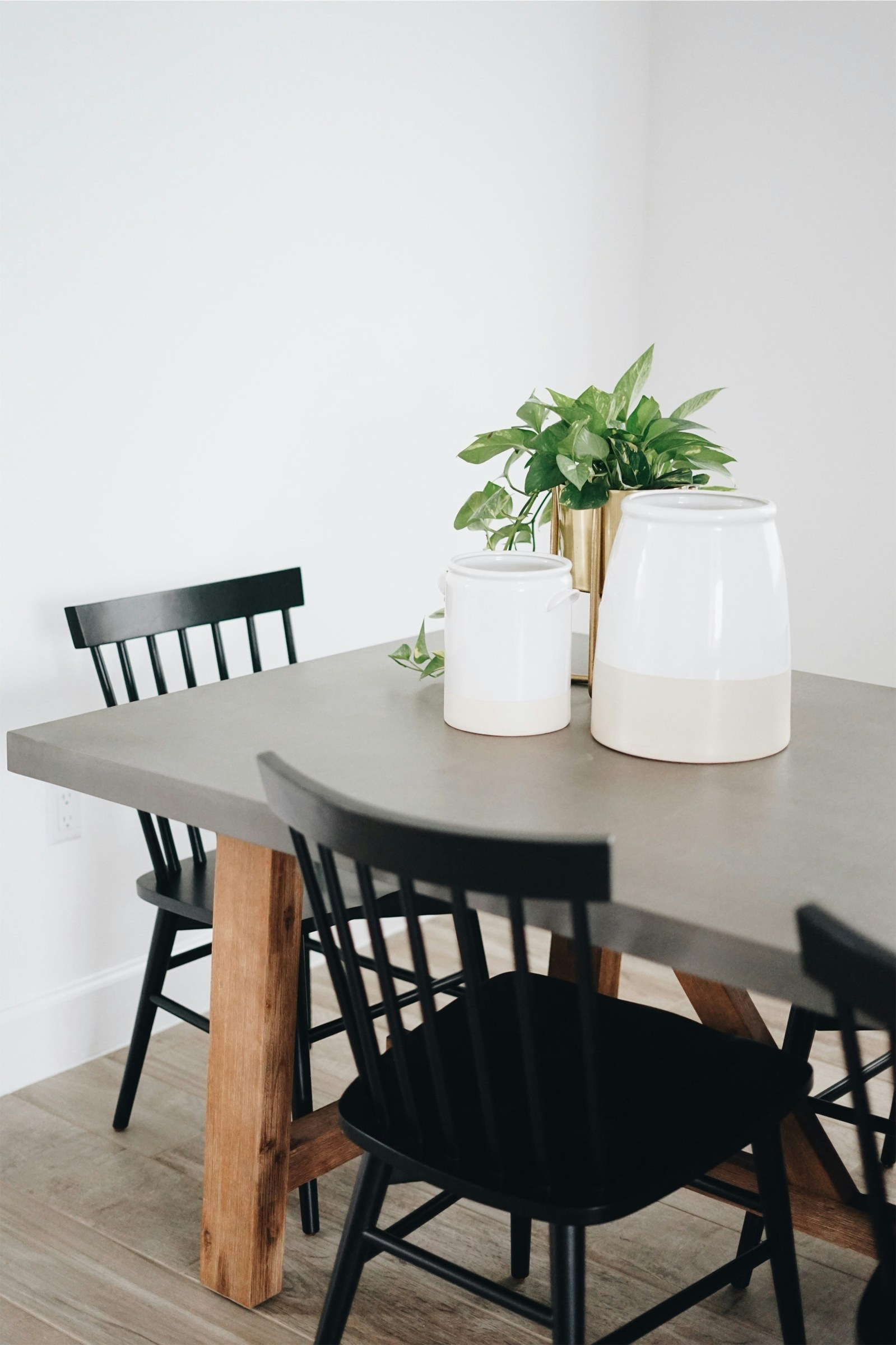
Pick open chair backs when you want to see through
These black chairs have open backs, so the pale wall and a little green plant remain visible beyond the dining table. The chairs provide contrast without filling the space between tabletop and wall with opaque panels.
This is worth considering in a small dining zone that is seen from the sofa, doorway, or kitchen. Stand at that normal viewing point and compare an open-back chair with a padded high-back model. Decide how much of the wall, window, or artwork you want to remain visible.
A lower, open silhouette is not automatically the more supportive option. Make sure its curved or slatted contact points suit the people who will use it. If an exposed back rail presses uncomfortably during a longer meal, the lighter look is not enough reason to choose it.
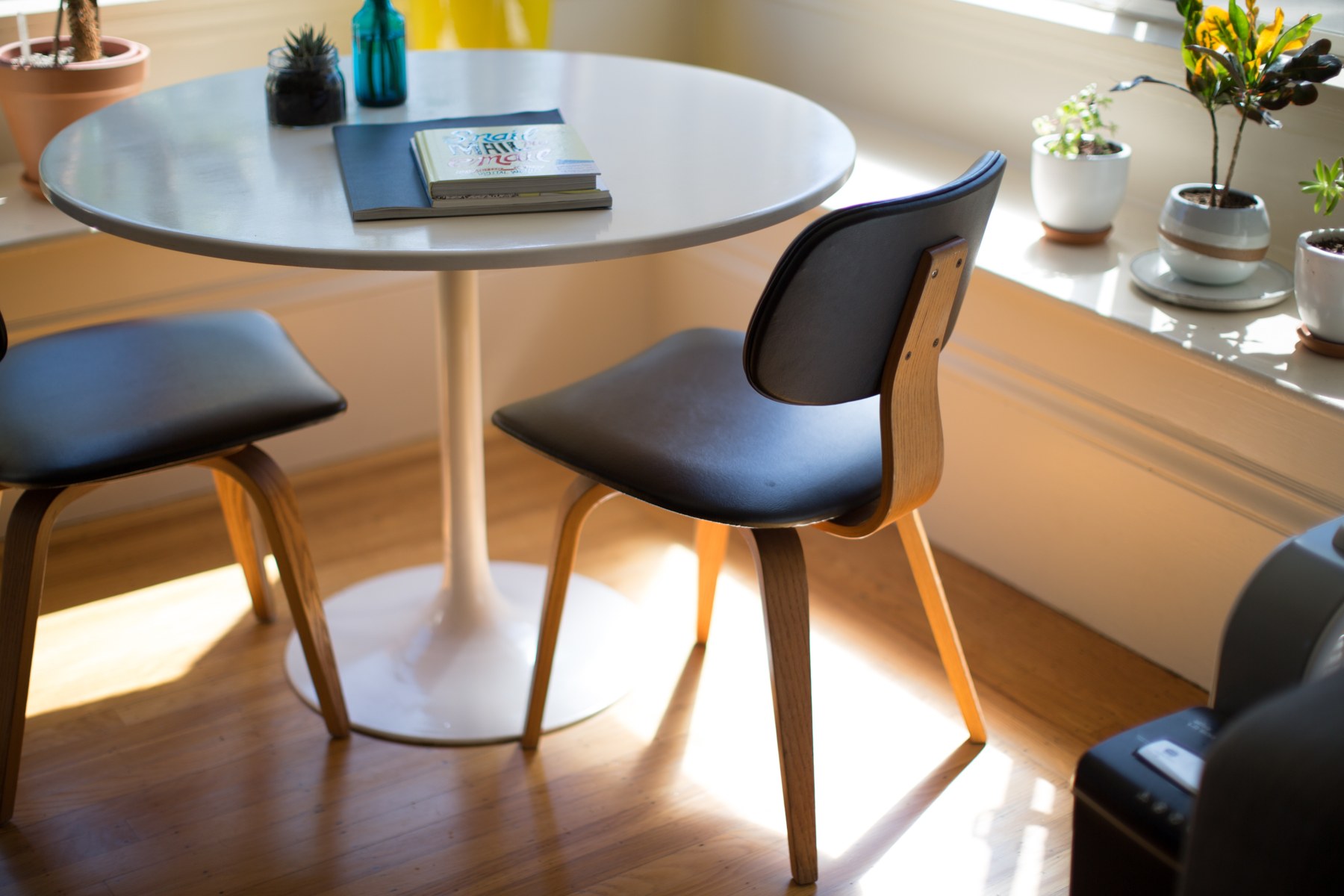
Judge the side profile, not just the front
Seen beside this pale round table, the molded chair’s curved wood-look back and angled legs are easier to understand than they would be in a straight-on product shot. The silhouette matters because chairs are often seen pushed in from across the room, not posed facing the camera.
When shopping online, inspect the side image and dimensions before falling for the front view. A seat can look graceful from the front but extend far under a table, or its rear legs can take more floor space than expected. Compare the back angle, seat depth, and where the chair frame meets your legs.
A good profile does not prove comfort. Sit with your feet on the floor, lean against the back normally, and pull in close enough to eat. For a round pedestal table like the one shown, also see whether the chair’s legs leave an unobstructed route around the base. At floor level, compare how far rear legs flare beyond the seat, whether nearby chair feet clash, and how the chair moves over any rug edge. Repeat the check with a table extension leaf in place. These are practical checks to perform at home, not dimensions that can be read from the photograph.
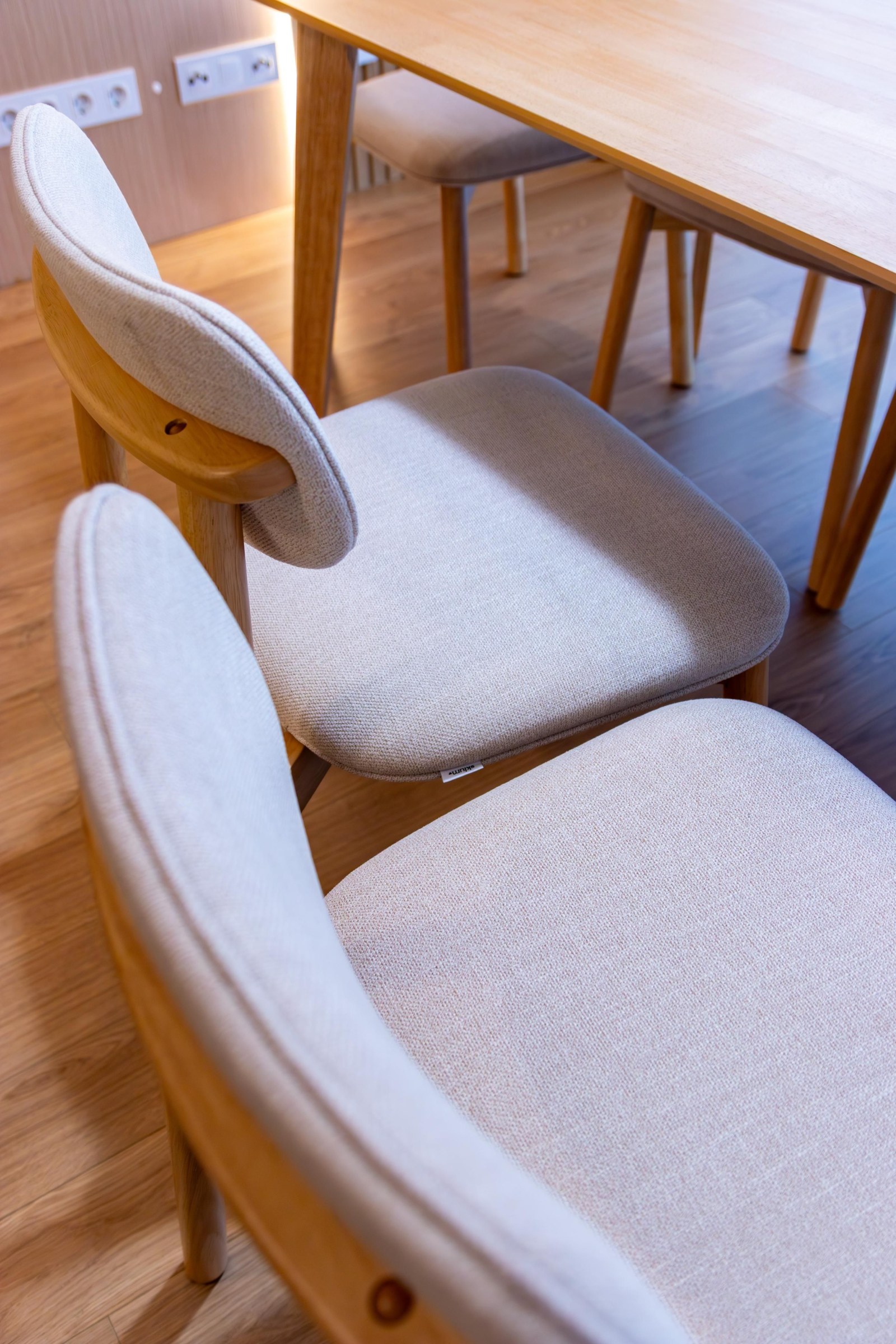
Study upholstery and construction up close
The close-up here shows light gray upholstery set within a pale wooden frame. It lets you compare the padded seat, curved back, and exposed wood parts; it cannot tell you whether the fabric is washable, stain-resistant, or suitable for your household.
Before ordering, ask for a swatch and the exact cleaning code or manufacturer’s care instructions. Test the chair for longer than a quick showroom perch: notice the cushion, the seat edge, the height of the back, and whether the frame feels stable when you get up. A padded surface is not by itself a guarantee of good support.
For a dining table that also serves as a workstation or children’s craft table, care may matter as much as looks. A wood seat avoids fabric cleaning but feels different during a long meal; a padded seat introduces upholstery that needs to be maintained. Choose for the way your own table is used.
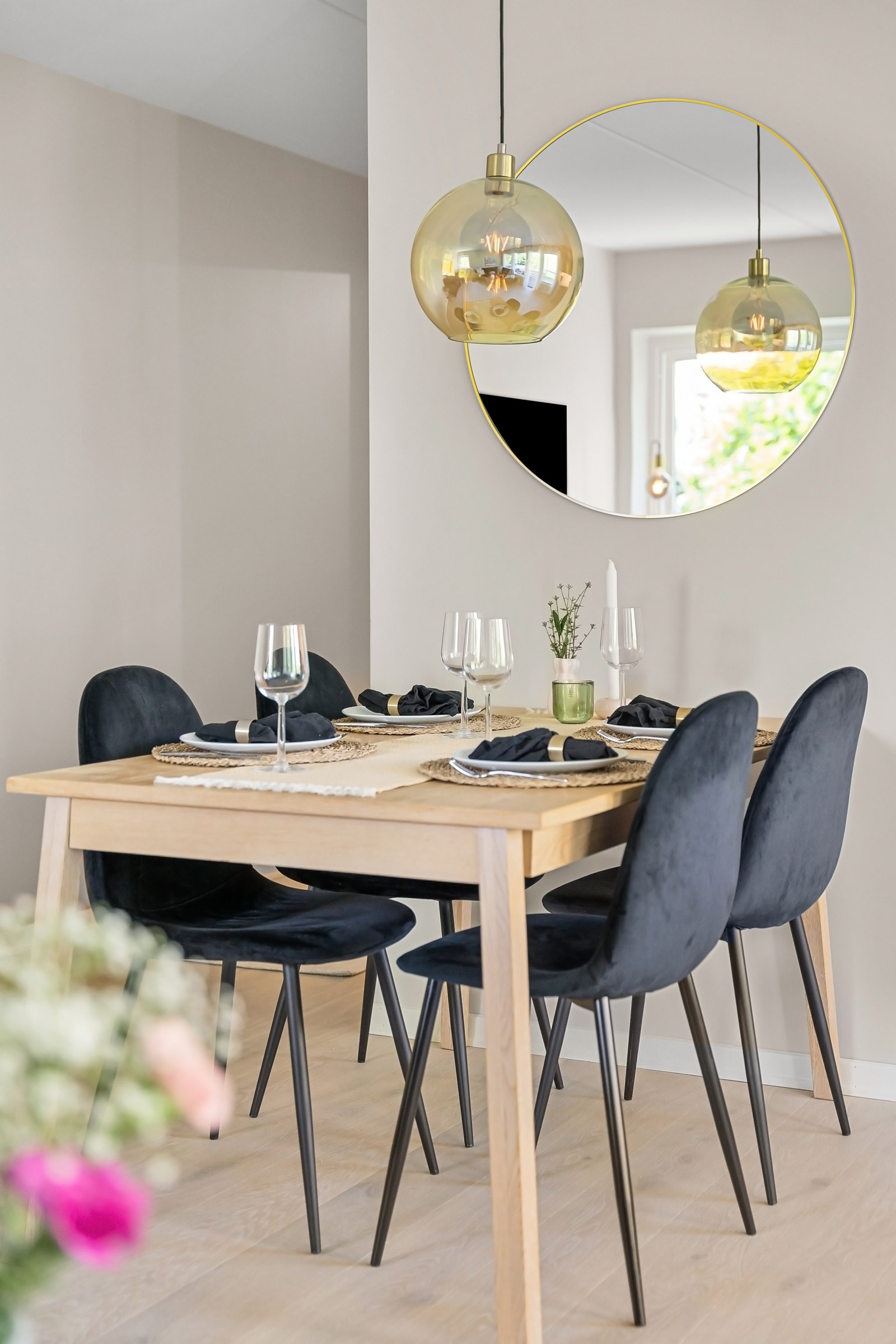
Let blue-gray upholstery supply the accent
Deep blue-gray chair backs are the one assertive color in this pale dining room. Against the light wood table and soft neutral walls, the chairs add definition without a brightly painted wall or a heavily patterned rug.
If you want to introduce color without replacing the table, repeat it in seating rather than in several unrelated accessories. Six colored backs will have a greater visual effect than one accent pillow, so compare the whole group from the entrance before ordering.
Blue-gray shifts with daylight and warm bulbs; a fabric sample seen in the actual room is more useful than a screen swatch. If a full set feels too strong, neutral side chairs with two colored end chairs can be another approach—but check that the chair heights and profiles work together.