COLOR

Green

Green interiors explored through sage, olive, forest and teal-leaning palettes balanced with wood, stone, metal and natural light.

COLORExplore this theme across different rooms, with advice you can apply at home.

EXPLORE BY ROOM

Green across the home.

Open the most relevant guide for each room in this theme.

MORE GUIDES

More ideas to explore.

Related guides explore this theme through different rooms, materials and design decisions.

Contemporary bathroom featuring two green washbasins, mirrors and coordinated vanity accessories

Green Bathroom Ideas

Green bathroom ideas are strongest when the shade is treated according to its role and associations rather than as a generic nature color. Sage can act almost neutral, olive can behave like an earth tone, emerald can become a jewel surface and forest green can cross into near-black architecture. Green also sits unusually close to timber, stone, plants and heritage cues, so the supporting materials decide whether the result feels calm, botanical, historic or sharply contemporary.

Explore the guide →
Real bedroom with deep green walls, white and gray bedding, two botanical prints and a small round bedside table

Green Bedroom Ideas

Green bedrooms become distinctive when green is treated as part of a material and living system rather than as a generic restful color. Sage can behave like a mineral neutral, olive can connect strongly to timber and earth tones, emerald can become a jewel field and forest green can cross into near-black at night. The design challenge is to control those relationships—wood temperature, botanical cues, plant viability, daylight and seasonal change—so the room feels grounded rather than themed.

Explore the guide →
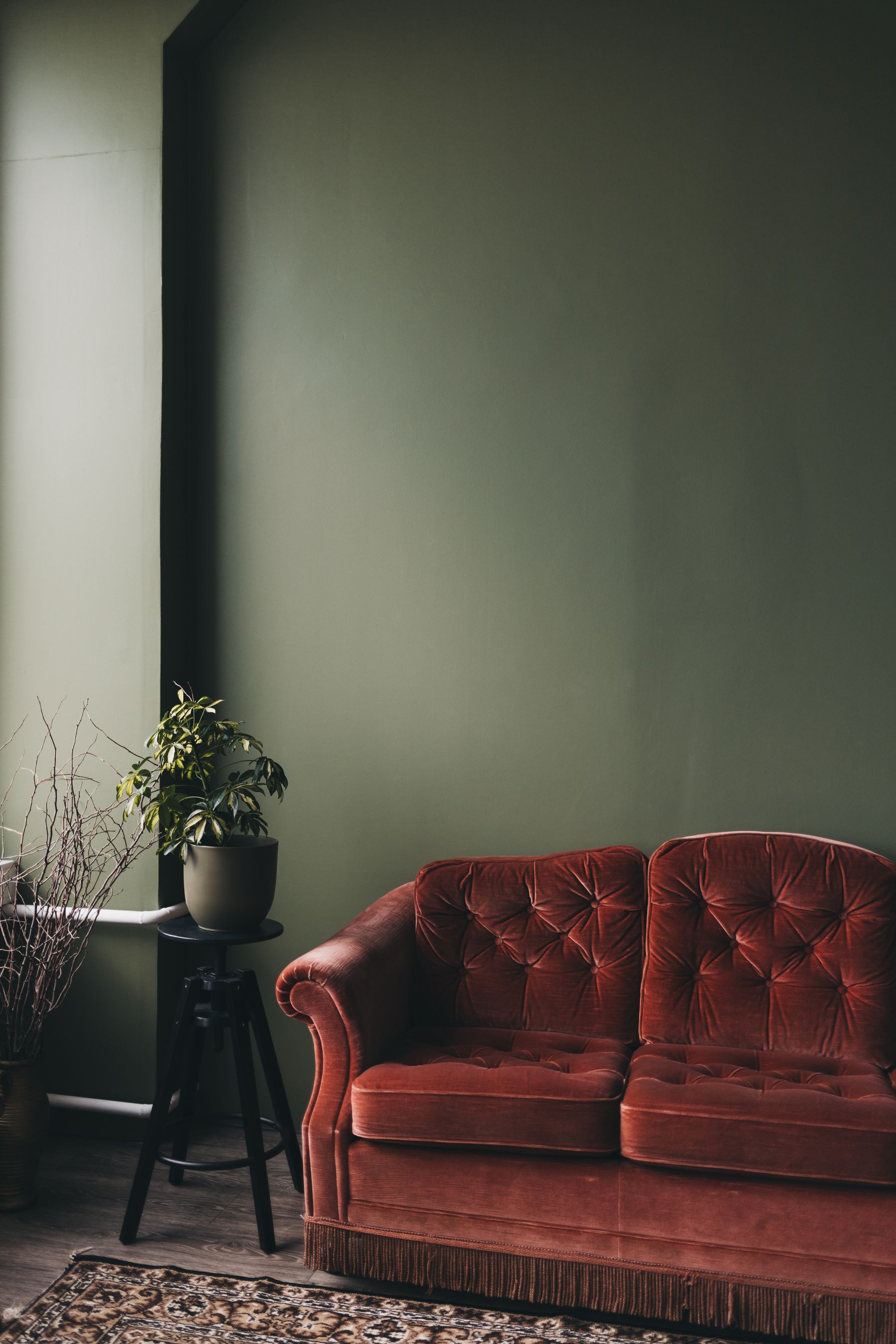
Rust-red tufted sofa and plants beside a tall green living-room wall

Green Living Room Ideas

Green living room ideas become convincing when green has a clear role in the room's social life. It can be the enclosing wall color, the largest upholstery volume, a continuation of the garden view or a deliberate counterpoint to it—but asking one green to perform all four jobs usually produces a themed room rather than a composed one. This guide focuses on the decisions peculiar to a living room: how green changes faces and conversation light, where a sofa ends against a green wall, how televisions and fireplaces interrupt the field, when red or blue improves the palette, and how adjoining rooms should meet it. The aim is not a shade catalogue or a botanical checklist; it is a living room whose green still works when the plants, cushions and daylight are stripped away.

Explore the guide →
Bedroom with deep forest-green walls, white grid bedding, black metal bed, two windows and warm brass lighting

Dark Bedroom Ideas

Dark bedroom ideas are broader than black paint and more practical than a mood-board label. A successful low-value room may be led by navy, forest green, charcoal, deep brown, aubergine or black, with enough tonal separation for the bed, storage, controls and circulation to remain usable. This guide covers palette choice, sampling, wall scope, ceilings, beds, textiles, materials, daylight, artificial light, windows, flooring, storage, mirrors, small and large rooms, work zones, rentals, accessibility and maintenance. It keeps Dark Bedroom distinct from [Black Bedroom Ideas](/bedroom/black-bedroom-ideas/), where black is the dominant hue, and from Dark Academia, where books, heritage references and scholarly atmosphere define the style.

Explore the guide →
Dark modern living room with deep-toned furniture, wall-mounted television and subdued lighting

Dark Living Room Ideas

Dark living room ideas are not a shortcut to black walls, Gothic drama or generic coziness. A socially useful dark room is a low-luminance composition: several deep color families, a readable middle value, small returns of light and controlled transitions between the bright window, the television, people's faces and adjoining rooms. This guide treats navy, forest, charcoal, espresso, aubergine and black as different kinds of darkness. It shows how to place the deepest field, build brightness bridges, keep dark-on-dark seams legible, choose night-window behavior and create separate conversation and screen hierarchies without bleaching the room with pale contrast.

Explore the guide →