Let a pale wood table soften an open room
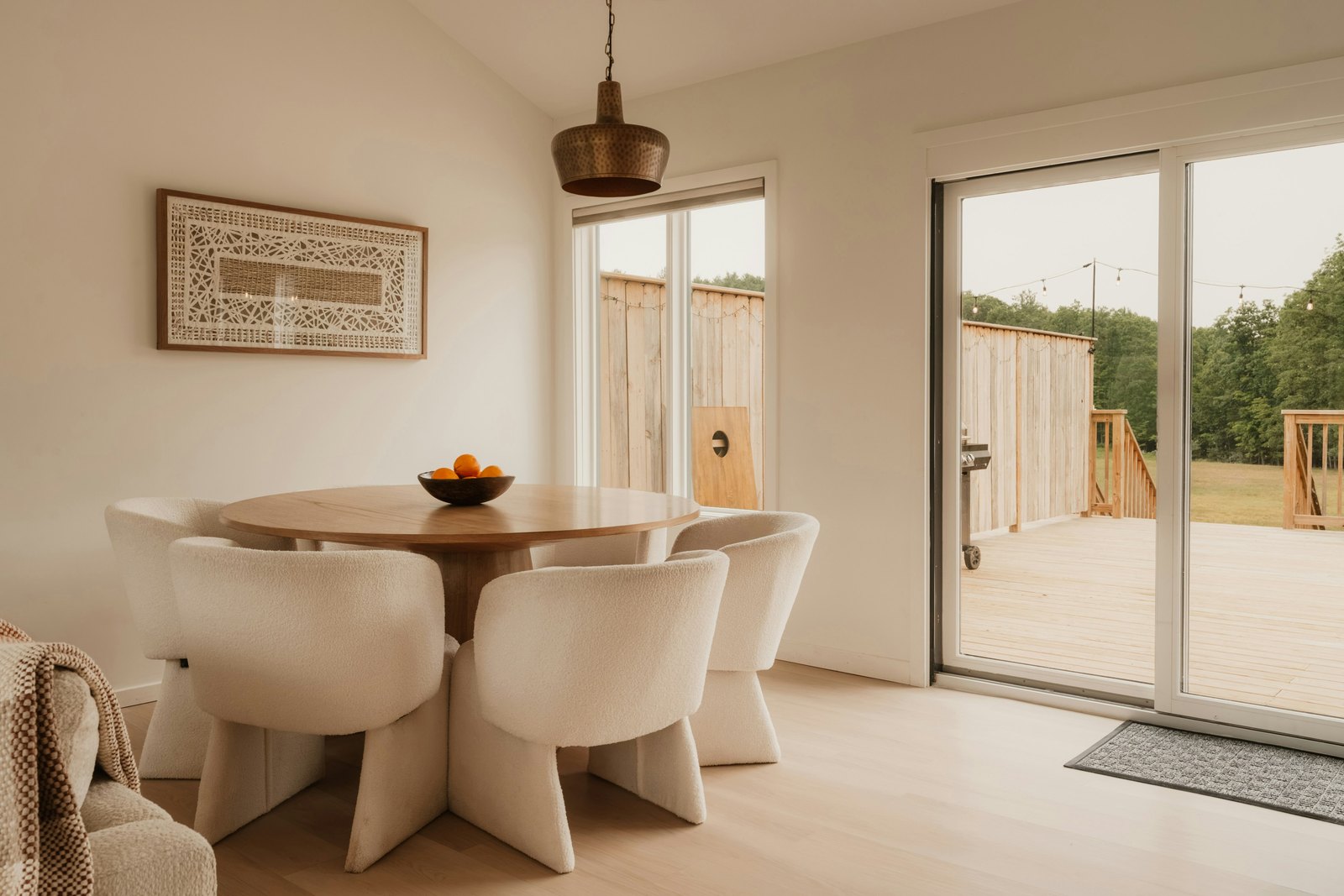
The pale tabletop, cream upholstered chairs, and similarly toned floor make this dining group feel like part of the larger room rather than a separate block of furniture. The round top still defines a place to eat, but the colors keep the view toward the glass doors open.
Those upholstered chairs are visually soft, not physically small. Their wide backs and deep seats require more pullback room than the table alone suggests. In a room with sliding doors, try the chair nearest the doors at its fully drawn-out position and walk through. Choose this low-contrast look when circulation space is generous; do not count on the palette to make a tight route work.
Try a pedestal when legs interrupt the seating
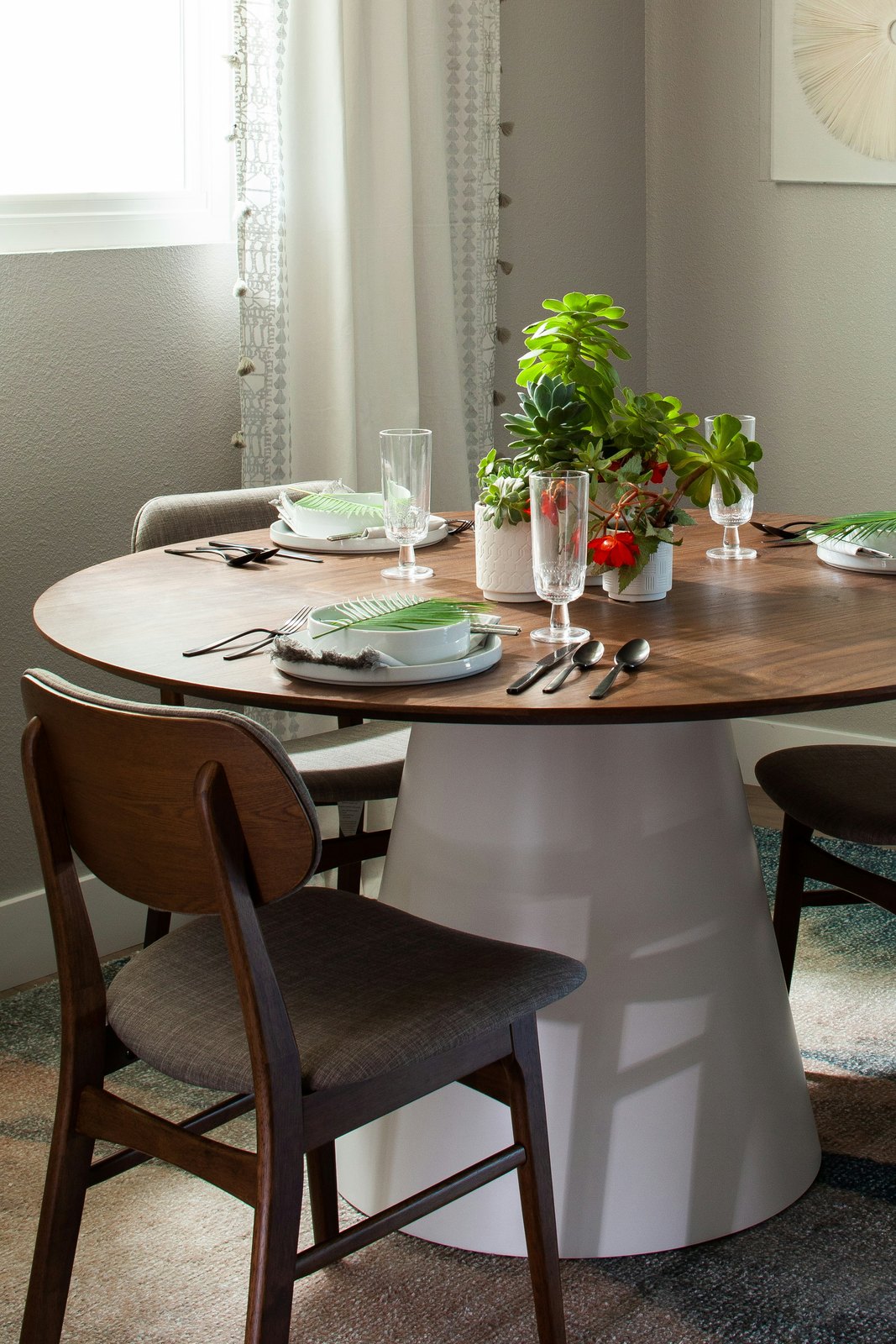
A pedestal leaves the perimeter of a round tabletop free of four conventional legs. Here a broad, pale cone supports a warm wood-grain top while darker chairs sit at different angles around it. Room & Board notes that pedestal bases can help make more seating positions usable.
The trade-off is at floor level. This cone flares outward where feet need to go, so test the base against your knees and toes, not just against the chairs on a showroom floor. Ask for the base dimensions, any apron clearance, and the stability specification for the exact model. A pedestal creates flexibility; it does not guarantee more seats.
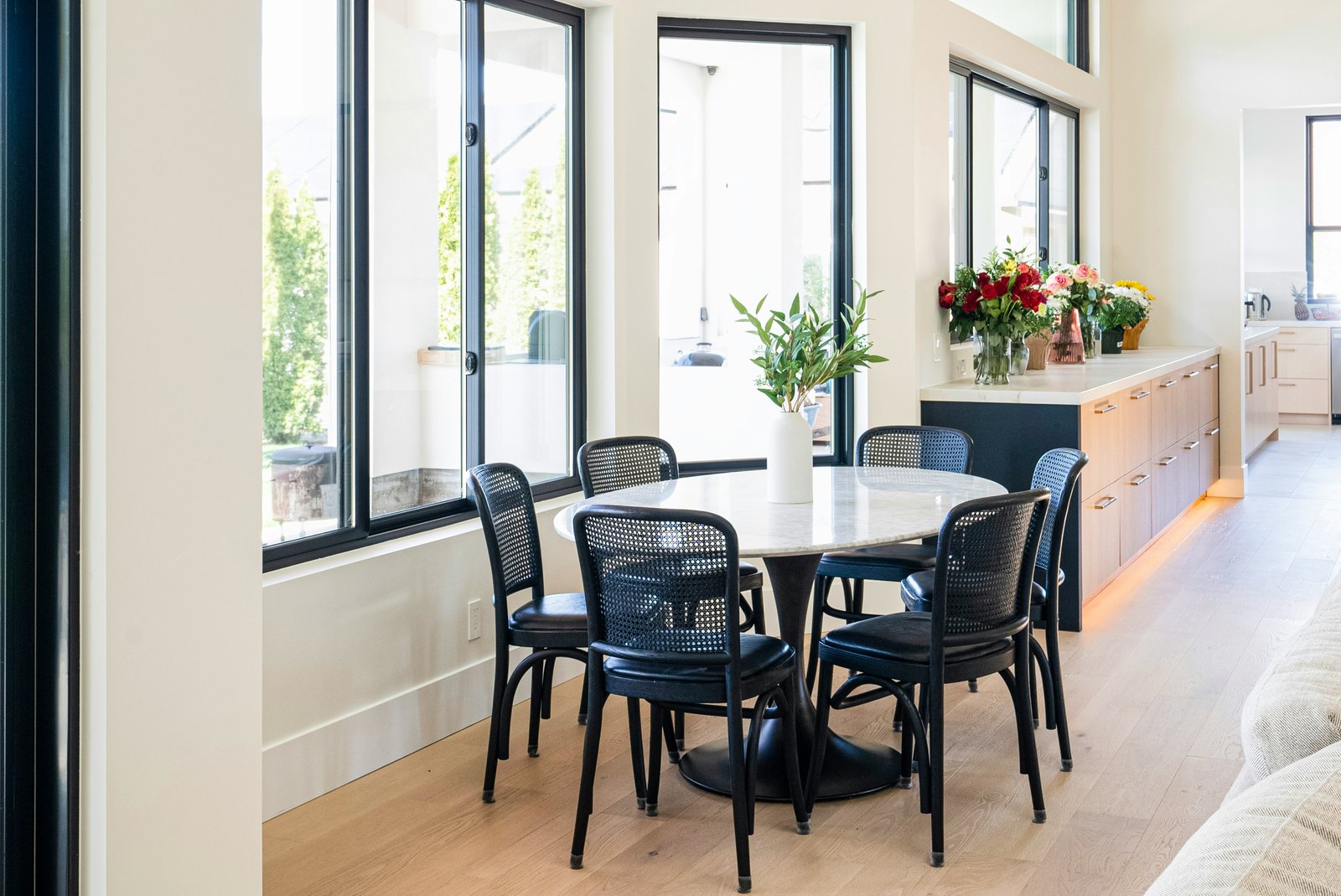
Pair a white top with open-back chairs
This white round table has a dark base that echoes the black window frames. The open chair backs let the pale flooring and long sightline stay visible, so the setup looks crisp rather than bulky.
Compare it with the cream upholstered chairs in the opening room. Both surround a circular table, but open dark frames draw its shape while full upholstery softens the group into the background. If your architecture already has strong black lines, the first approach makes sense; if you want the dining area to recede, choose the quieter palette. Neither changes the real clearance the chairs need.
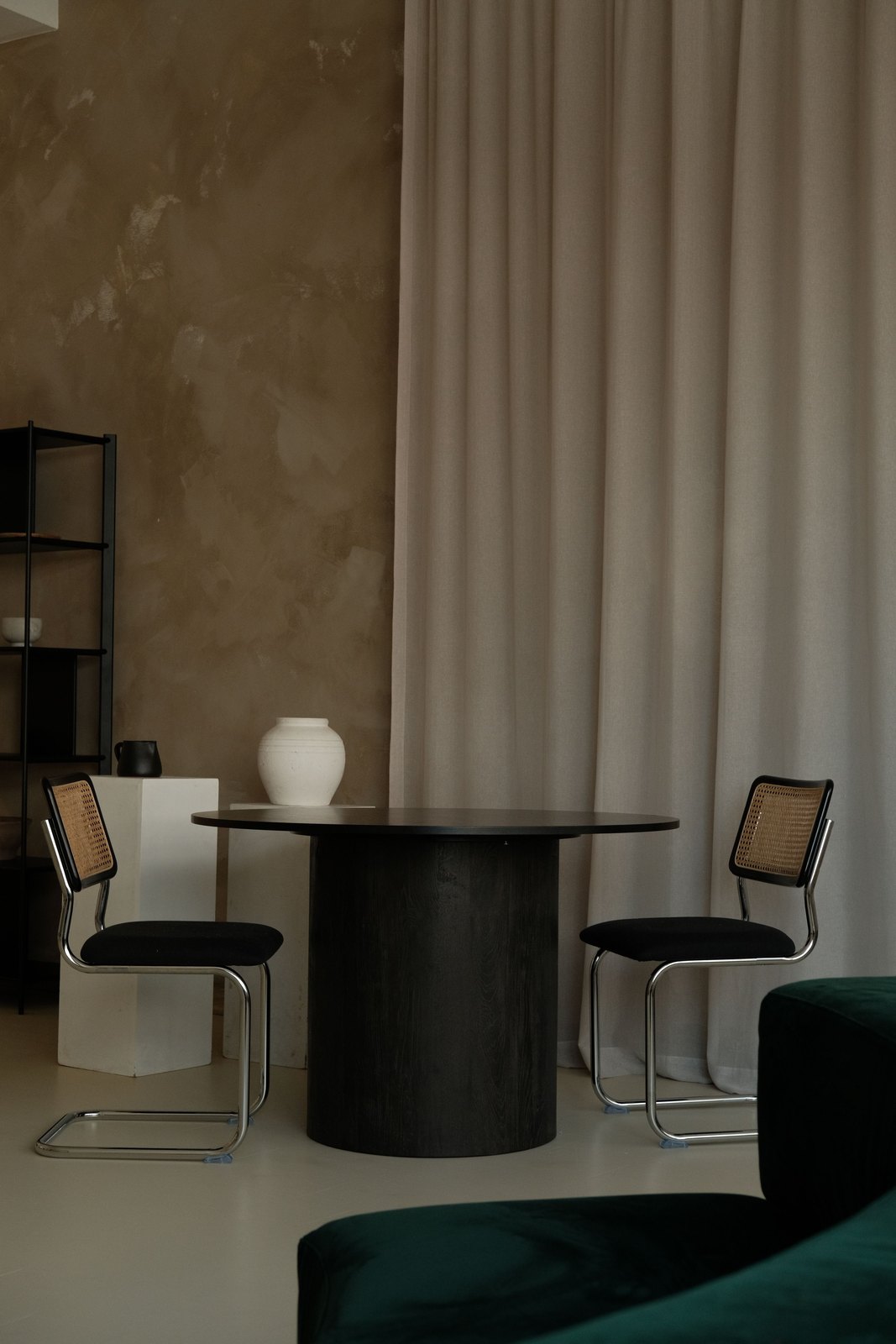
Choose a column base for a pared-back room
A nearly black round top on one cylindrical column becomes the most solid object in this sparse corner. Slim chrome chair frames create the opposite effect: a few light lines alongside one heavy form. That contrast gives the small dining area a point of view without extra decoration.
A column can crowd legs if its diameter is large relative to the top. Before buying, sit at each intended place and make sure your feet can move around the base. If you want a sculptural table but a softer room, the tapered pedestal above offers another way to give the base attention without making the entire piece read as a dark cylinder.
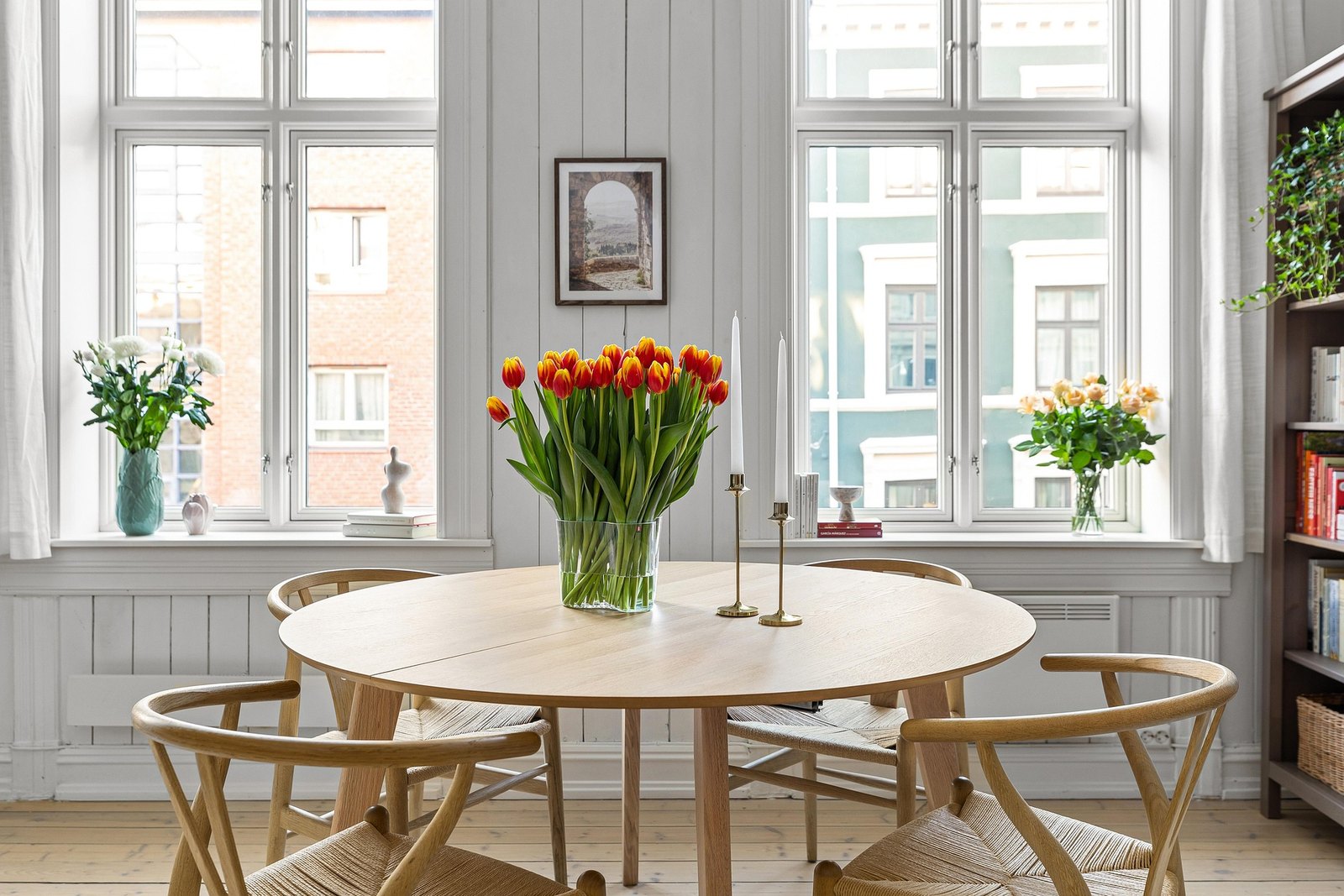
Set the table where the light is
The table sits between tall windows, and orange tulips mark its center against a broad wall of daylight. The light wood tones and curved chair frames keep the setting relaxed. Instead of pushing the table toward an arbitrary room center, the arrangement lets the windows define the dining spot.
Put a chair in each proposed position and look toward the glass at the times you normally eat or work there. Direct light can be welcome at breakfast but uncomfortable on a laptop screen. Also check the baseboard, radiator, sill, and curtains before moving the table close to the wall. The beautiful part is the view; the practical part is keeping the window and chairs usable.
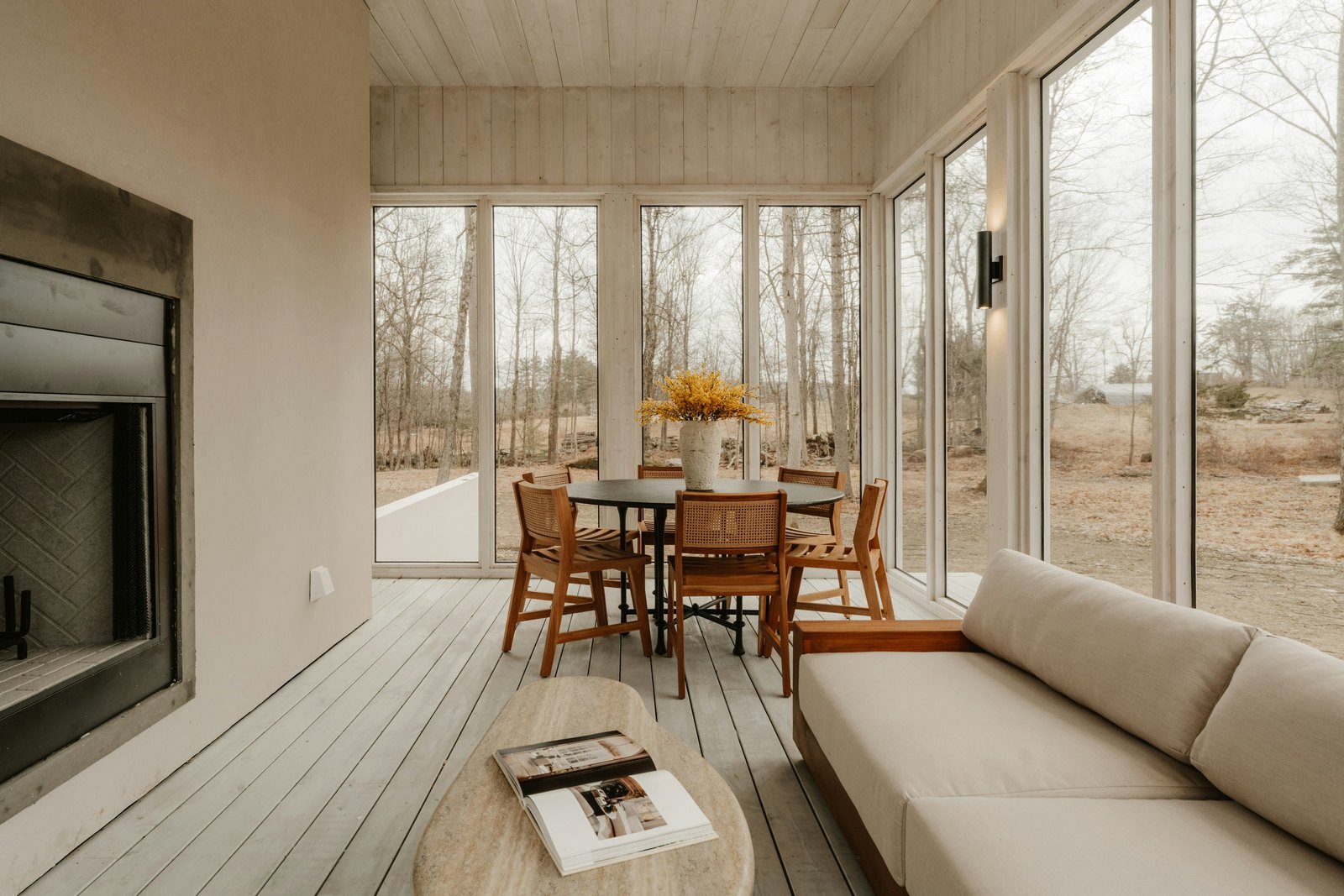
Anchor the dining end of a sunroom
In this glass-walled sunroom, the sofa occupies the near end and a round table takes the far end. The dining chairs face different parts of the outdoor view, so the table does not need one formal head position.
Treat the walk between the sofa and dining group as the deciding dimension. Pull back the chair closest to the sitting area and make sure the route to the doors stays clear. This is a zoning idea, not proof that any particular large diameter will fit; the table in the image is distant, and its size should not be inferred from the photograph.
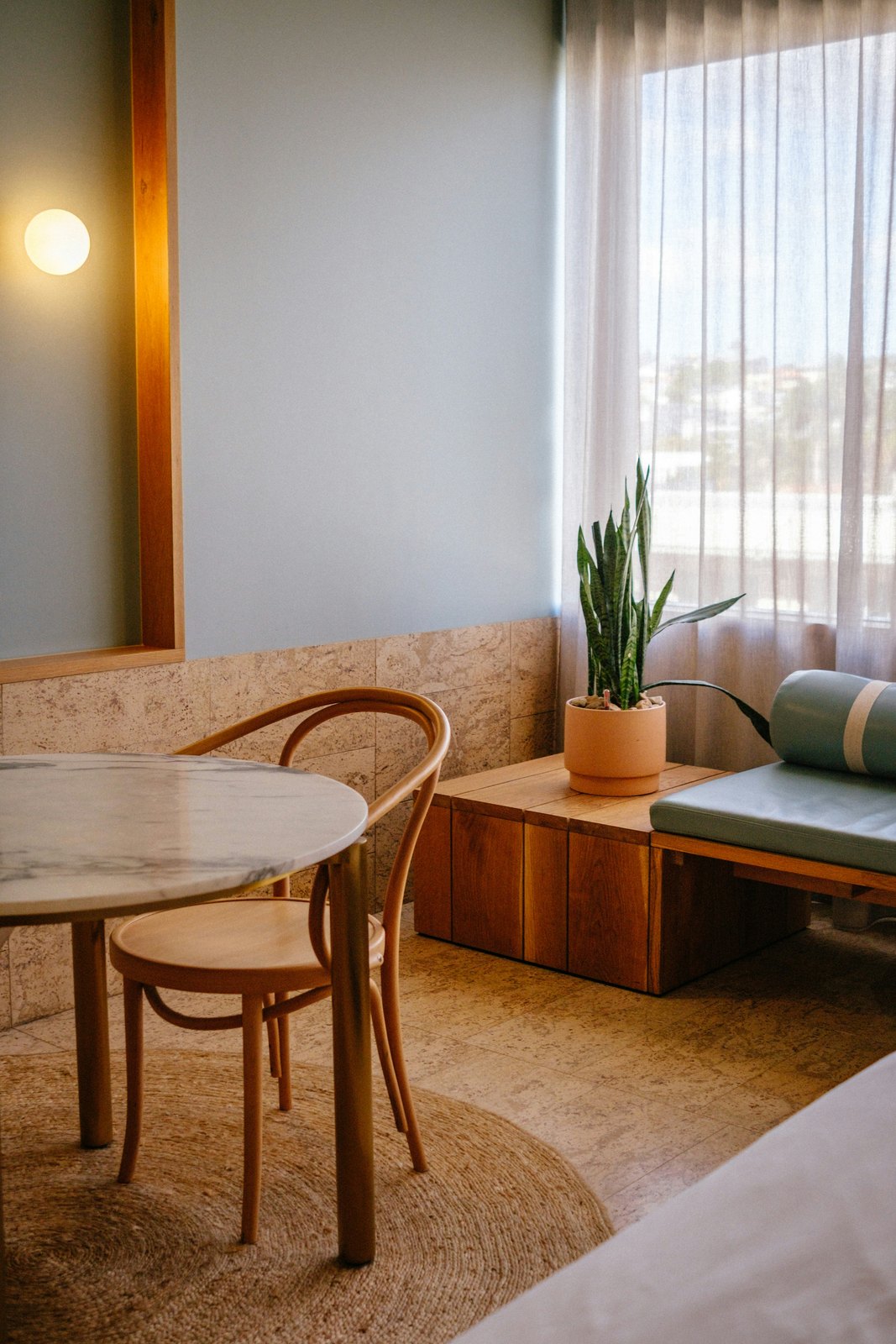
Give a small table a window seat as its neighbor
In this compact corner, part of a round tabletop sits next to a separate upholstered window bench. The bench belongs to a reading and resting nook; it is not tucked beneath the table as dining seating. Keeping the two functions distinct helps the small space do more than one job.
A round edge makes it easier to approach the nearby chair without a sharp table corner, but the route to the bench still matters. Pull the chair out, reach the seat and any storage beneath it, and check that neither piece has to move every day. This is a useful arrangement for coffee or a small meal next to a window, not a shortcut to counting the bench as another place at the table.
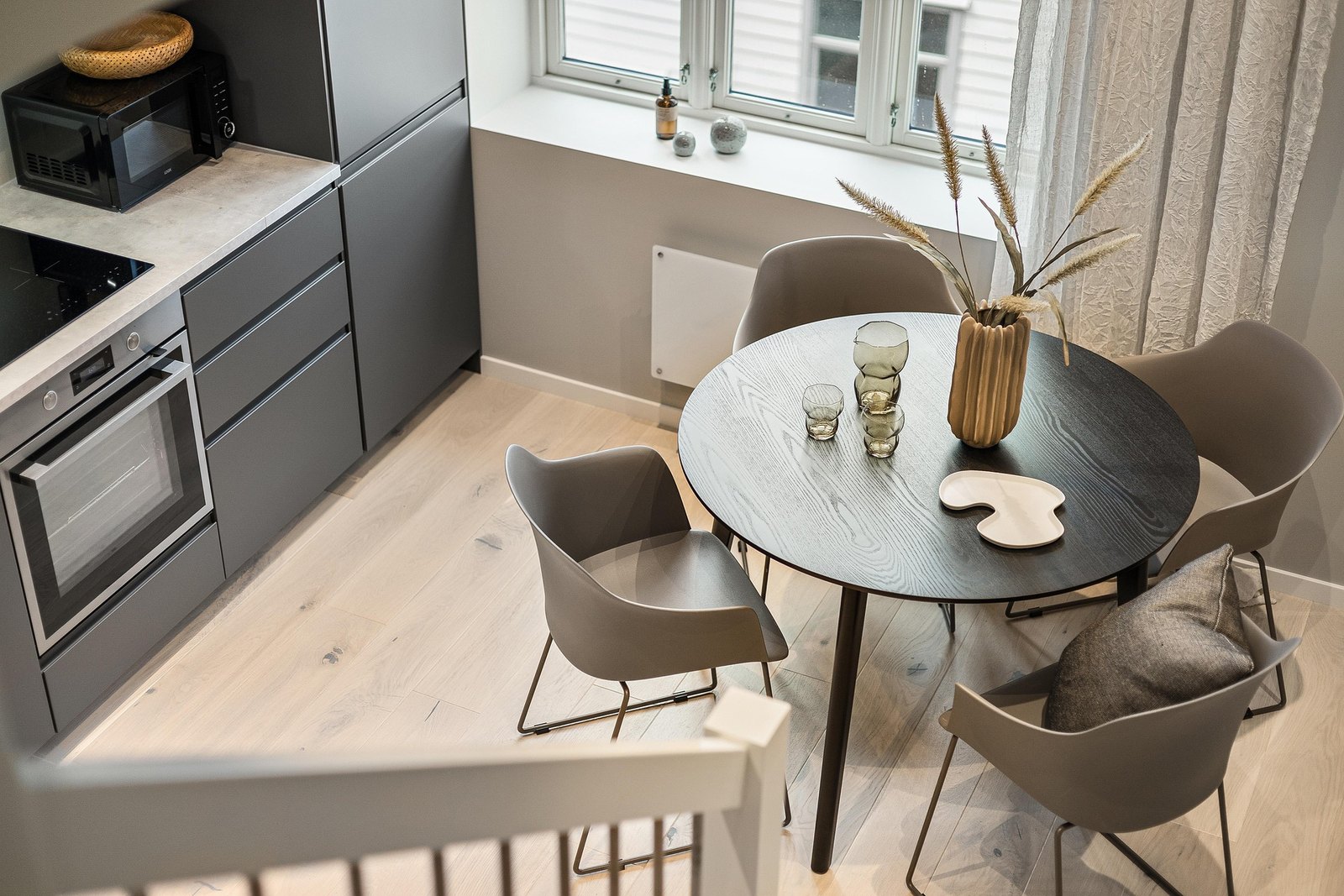
Tuck a round table beside the kitchen
This dark round table sits close to a short kitchen run, with gray upholstered chairs wrapping the side by the window. Its curved edge creates a gentler transition from cooking to eating than a projecting rectangular corner would.
Plan outward from the working appliances, not inward from the empty floor. Open the oven or dishwasher and pull back the dining chair closest to the counter; both positions need to work without conflict. Measure from the actual counter front to the table edge and include the pulled-out chair. Where the room is long and narrow, an oval may preserve a better route than a circle of similar seating capacity.
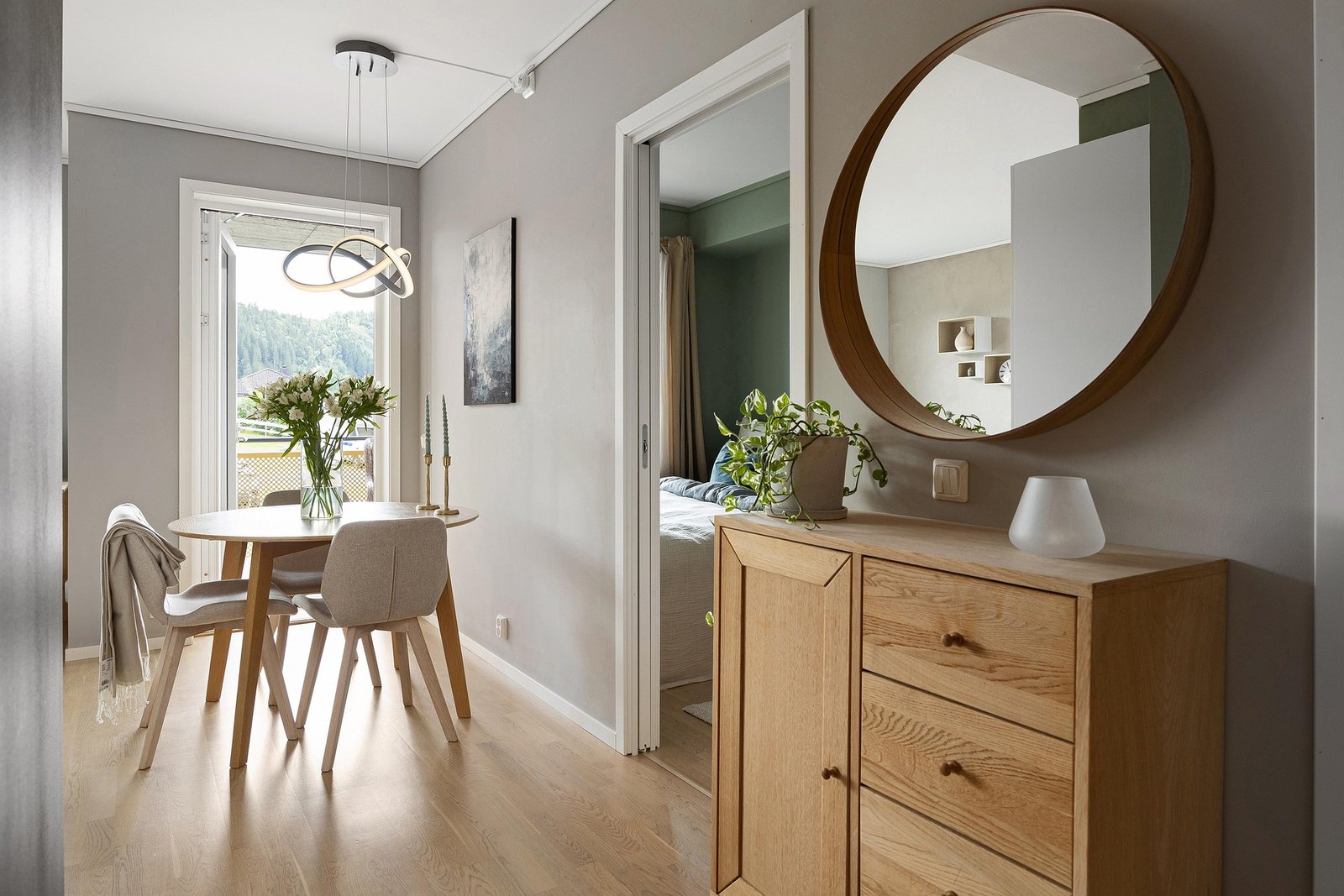
Let the doorway decide the diameter
A pale round table sits in a compact room with a doorway nearby and a chest of drawers against the wall. The furniture looks light, but the key question is what happens when someone stands up. The photograph alone cannot establish a blocked route.
Mark the proposed table diameter on the floor and place a real chair where the doorway-side seat would go. Pull it back, open the door, and walk through without turning sideways. If that sequence fails, try a narrower diameter or a smaller chair before deciding the whole idea is impossible. A circle removes sharp corners; it does not remove chair traffic.
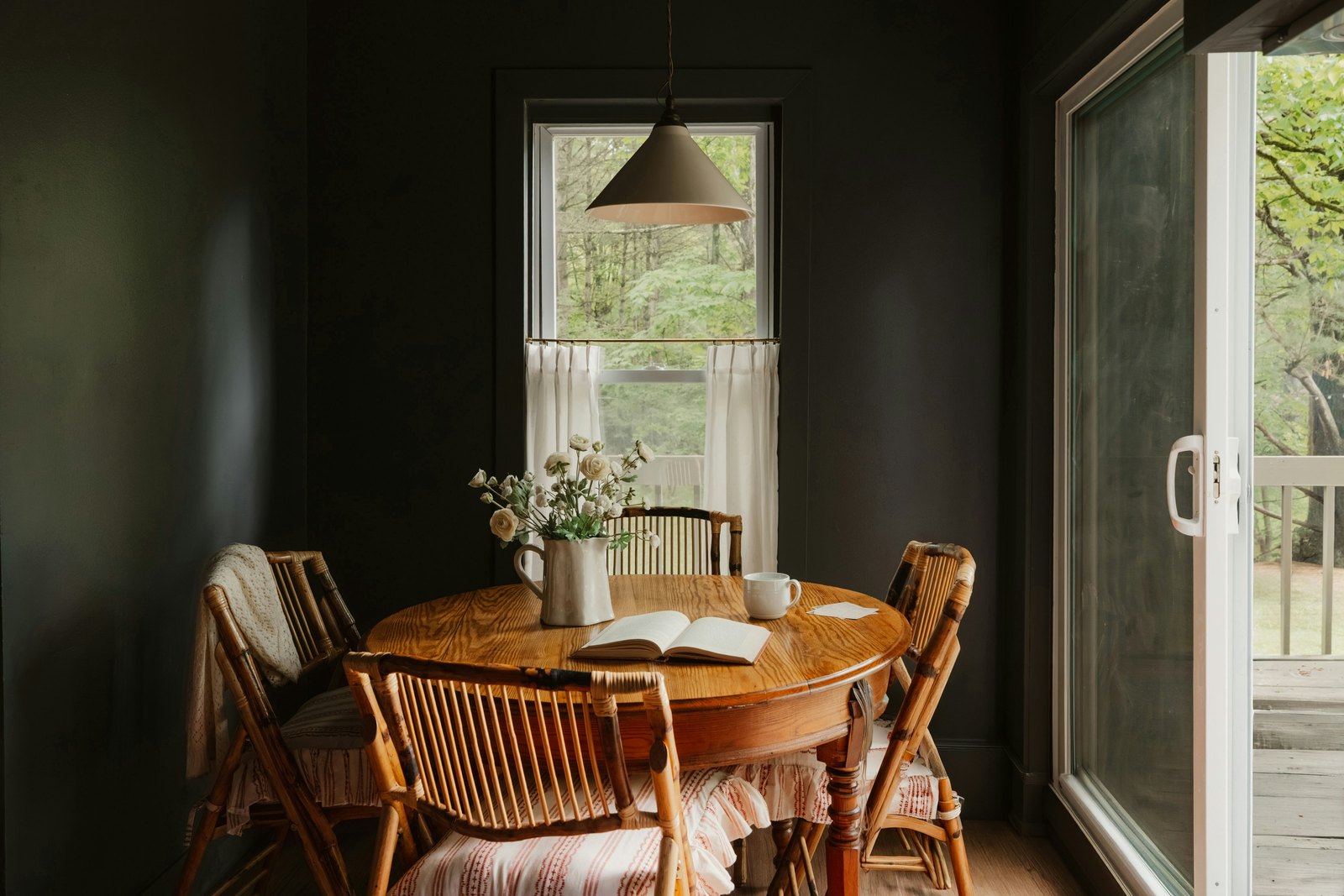
Warm up dark walls with a honey-toned table
Warm wood separates this round tabletop from the deep green-gray walls. Light from the window picks up its grain, while woven-looking chair backs and a simple cone pendant continue the warm palette. The result feels rich without brightening every wall.
Use this approach when you want a dark room to retain its mood but still need the dining surface to register clearly. Bring a sample of the proposed tabletop finish into the space and view it in morning and evening light. The photograph supports the color relationship, not a claim about the exact wood species or paint code.
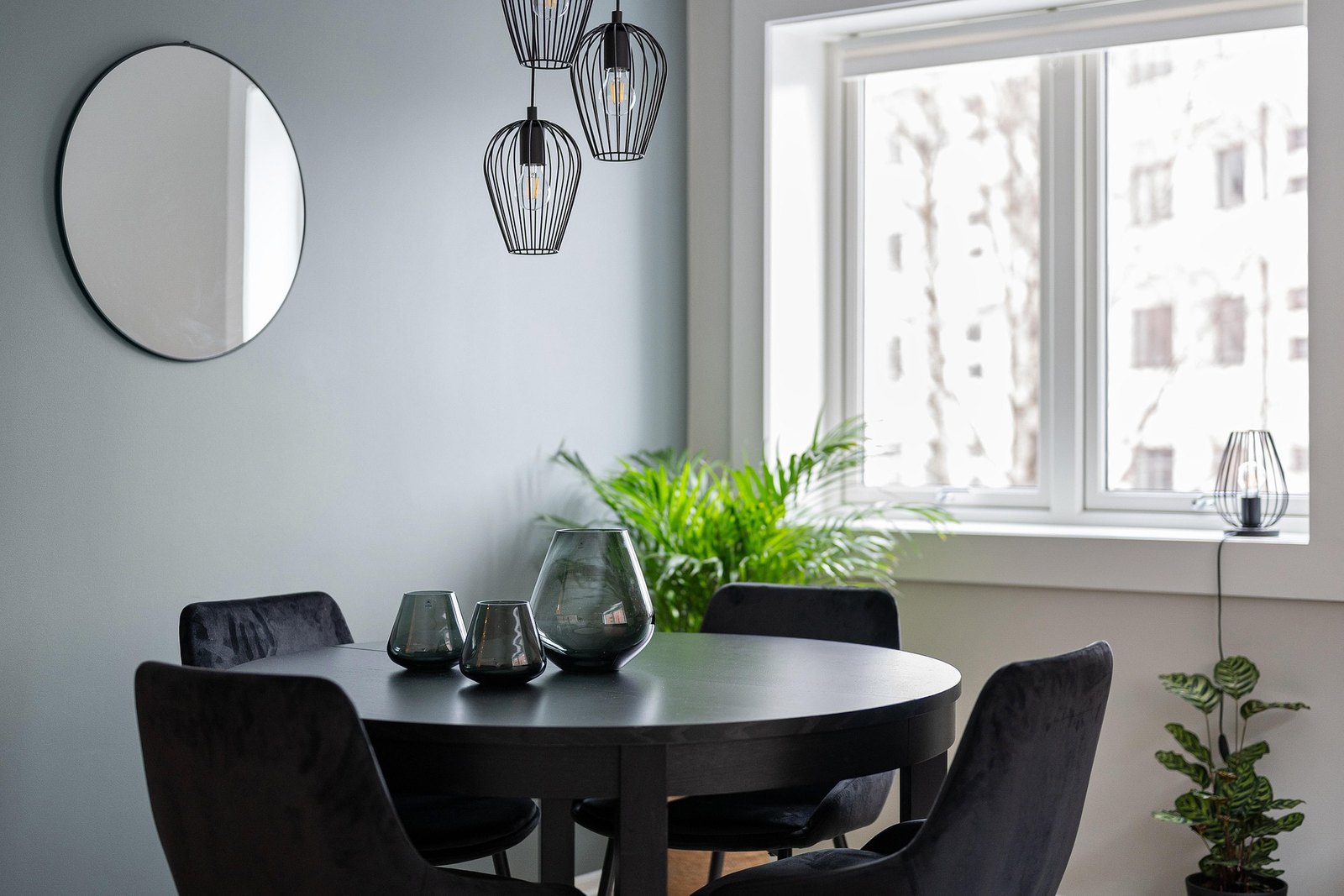
Try a dark table against a cool wall
Here a nearly black circular table sits against a cool-toned wall, and a round mirror repeats the tabletop shape at eye level. Rather than making wood the warm accent, this room uses the table’s dark outline as the contrast.
That is a sharper, more graphic effect than the honey-colored table in the previous room. A mirror can repeat the circle without using more floor space, but its location should be checked for reflections from windows or lighting. Ask how the actual tabletop finish cleans and wears; the photograph does not identify the finish.
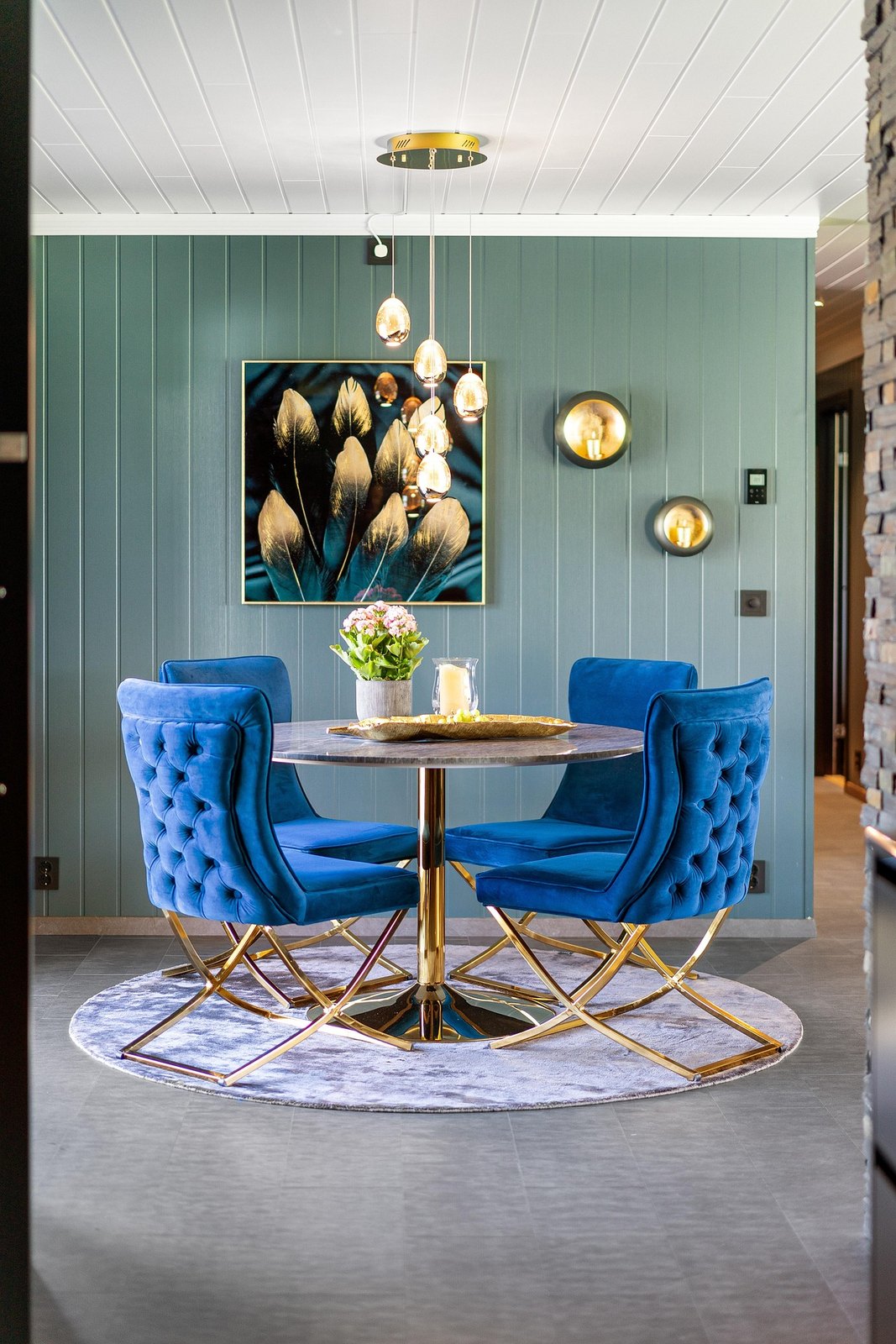
Match the round tabletop to the chairs’ real size
Four generously upholstered blue chairs gather around a relatively small round top: two face the camera, with two more visible behind them. The narrow center support leaves an open perimeter, but the upholstered seats occupy far more space than the tabletop suggests.
Before planning four places around a small circle, set out the plates and glasses your household actually uses, then test the exact chairs for elbow room, knees, and pullback. If diners feel crowded, choose a larger top, slimmer chairs, or fewer everyday seats. The strong blue makes the arrangement memorable; the table-to-chair proportion decides whether it is comfortable.
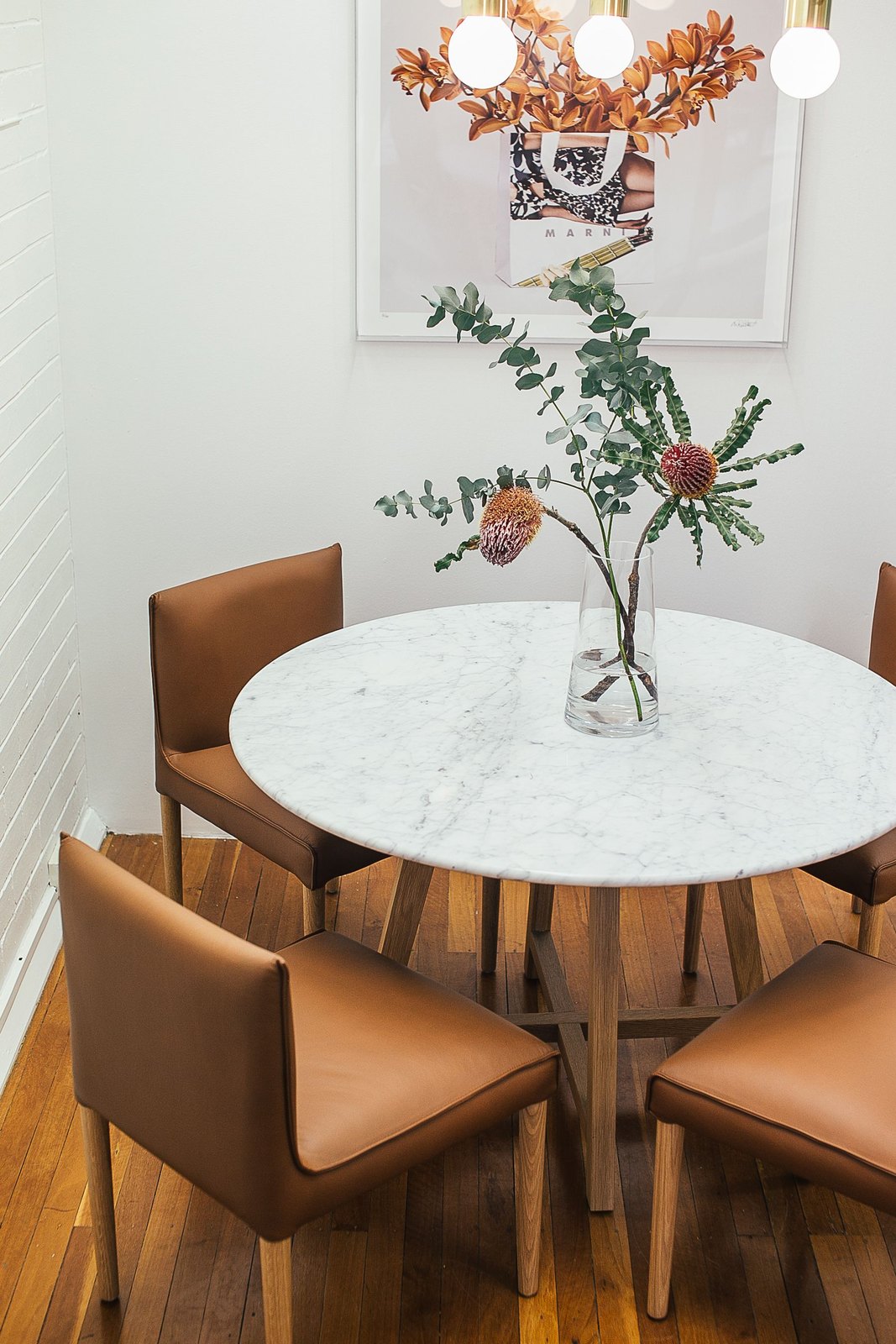
Pair a pale, stone-look top with warm seating
A light, veined round tabletop sits among warm brown upholstered chairs. The cool, patterned surface and warmer seating make the small dining area feel layered without an elaborate color scheme.
From a photograph you can see the pale veining, but not whether the surface is marble, quartz, laminate, or another material. If the look appeals to you, compare samples and the exact care instructions for stain, heat, and scratch resistance before choosing a tabletop. The high, upholstered chair backs also make this a fuller-looking group than the open-frame option earlier.
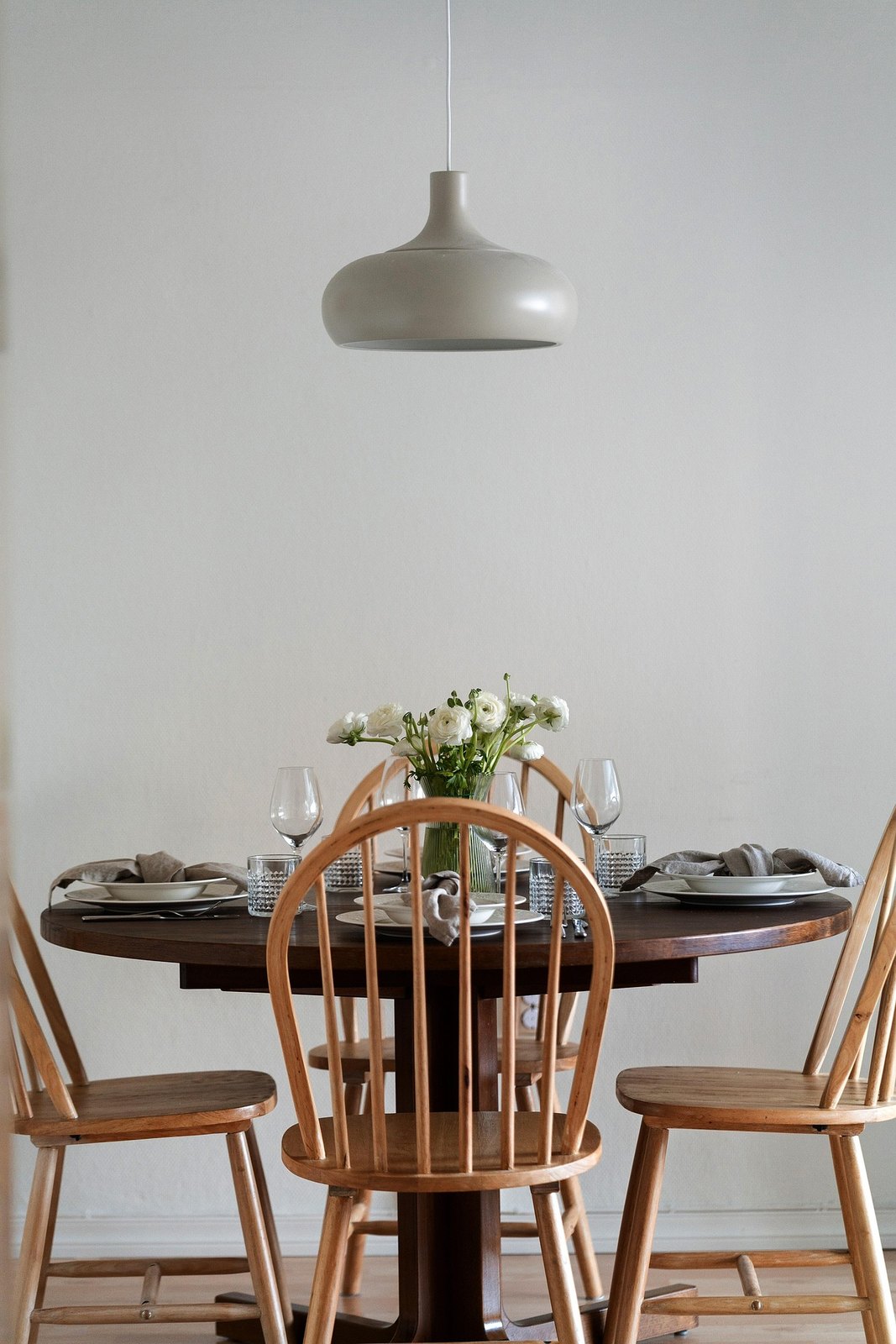
Hang one pendant over the table, not the room
A simple light-colored pendant floats above a dark round top and spindle-back wood chairs. The fixture provides a clear center without competing with the spare room. Its apparent height keeps the wall feeling open, although the photograph cannot give an exact drop.
West Elm recommends centering a pendant on the table and starting with its bottom 30–36 in (76–91 cm) above the tabletop. Treat that as an adjustable reference, not a measurement of this photographed lamp. Sit at the table and check views across it, bulb glare, and the apparent scale of the shade before the fixture is installed. Have hardwired work completed to local electrical requirements.
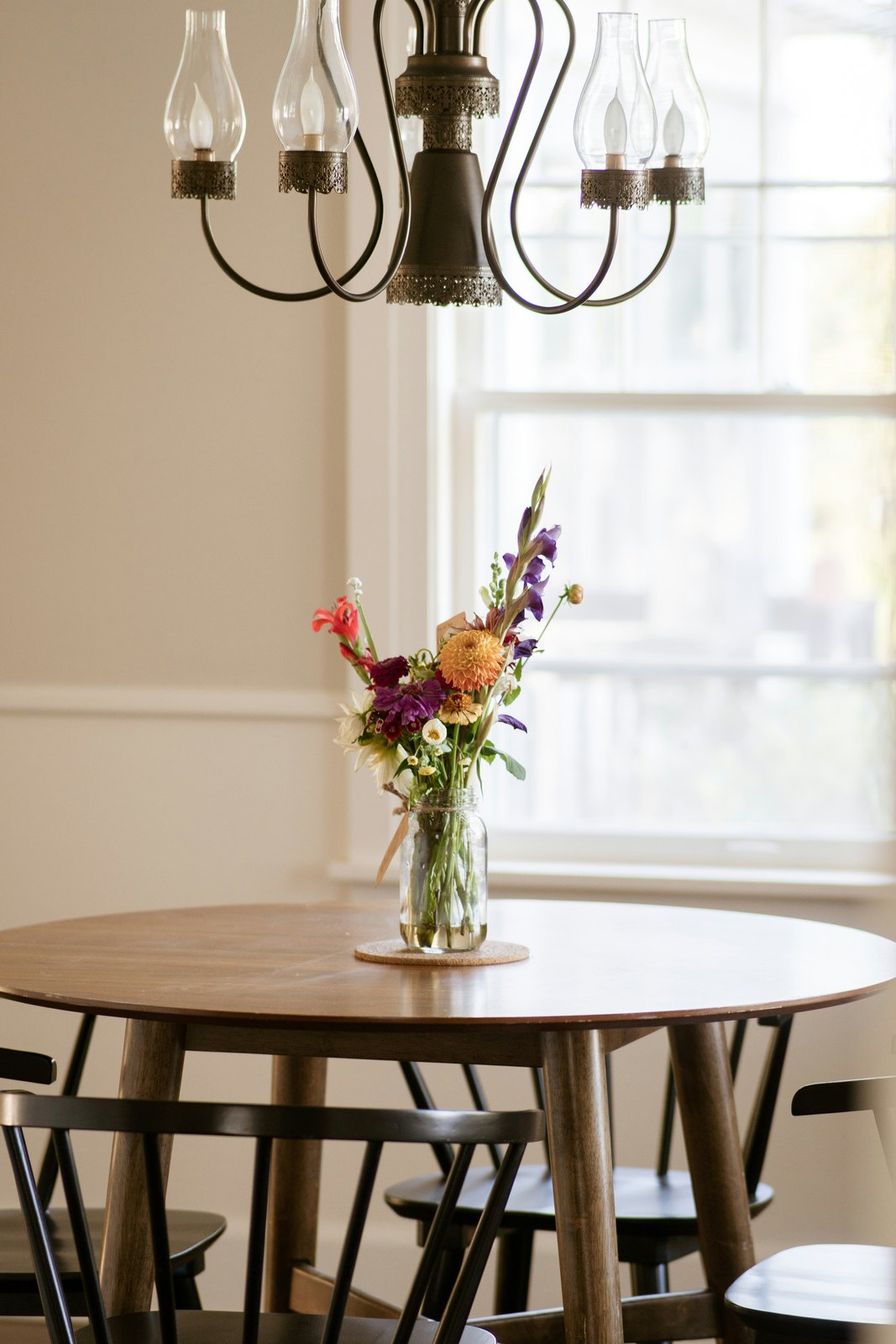
Give a simple table a sculptural chandelier
The chandelier’s curved arms gather above the center of this round wood table. Its glass shades and repeated curves provide more ornament than the single pendant in the previous example, while the table and mixed dark chairs keep the setting grounded.
Choose this more decorative silhouette when a simple table and restrained chairs need a stronger focal point. The single shade above the previous example stays visually quieter; here the branching arms become part of the room’s character. Sit at the table before deciding on the drop, checking that the fixture does not block conversation or put bulb glare into anyone’s eyes.
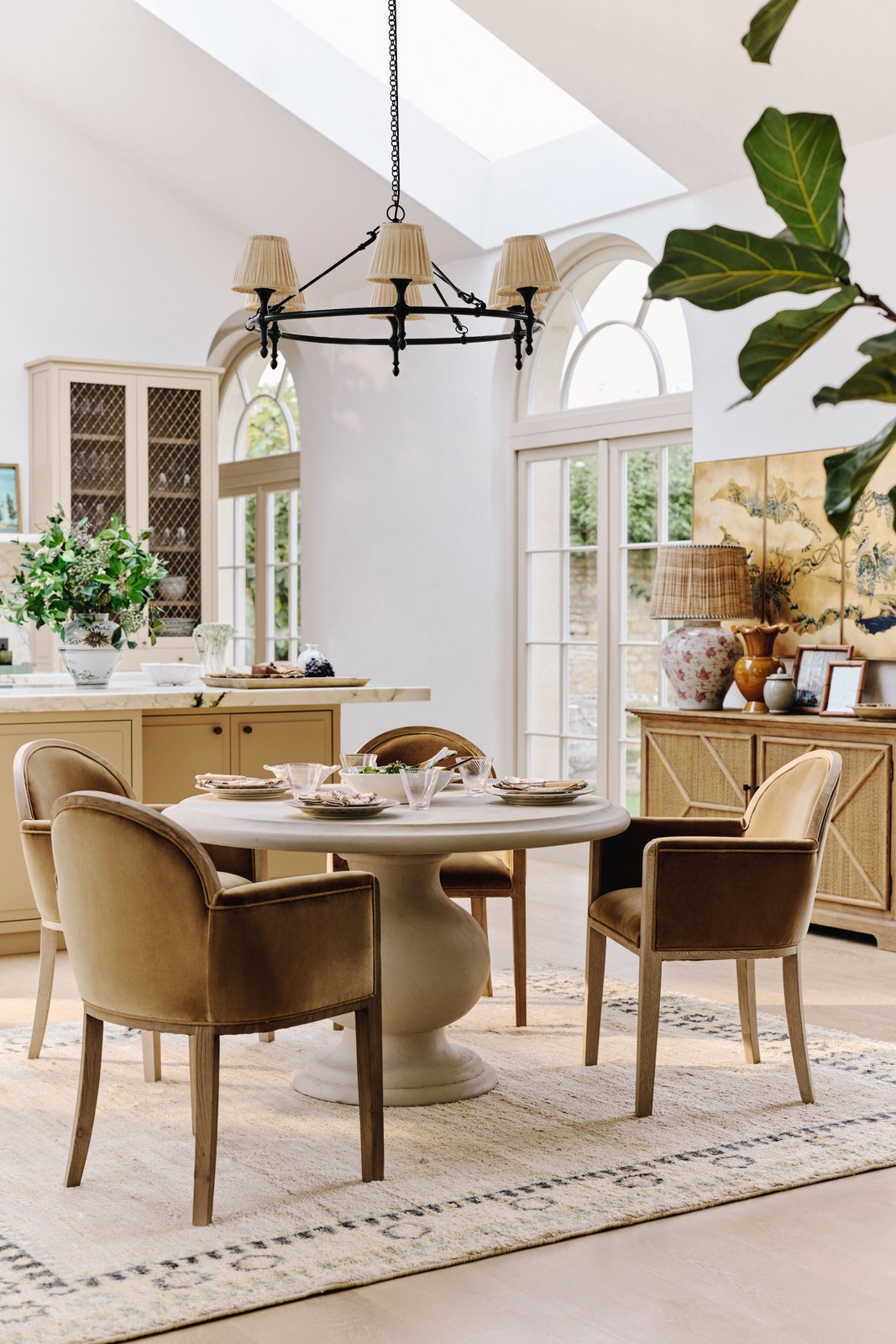
Layer a round table over a generous rug
In this OKA interior, a patterned rug gathers upholstered chairs around a pale round table and separates the dining area from the larger room. The rug is doing two jobs: adding texture and marking the usable area occupied by the chairs.
For a 48 in (122 cm) round table, Pottery Barn’s current dining rug guide illustrates a 7 ft (213 cm) round rug, while Ballard Designs suggests 8 ft (244 cm). The 7 ft (213 cm) option leaves about 18 in (46 cm) of rug beyond the table edge on each side; the 8 ft (244 cm) option leaves about 24 in (61 cm). Neither chart knows how far your chairs travel. Pull one fully back and keep all legs on the rug before ordering; in a frequently used dining room, a low-profile, easy-to-clean weave is practical.
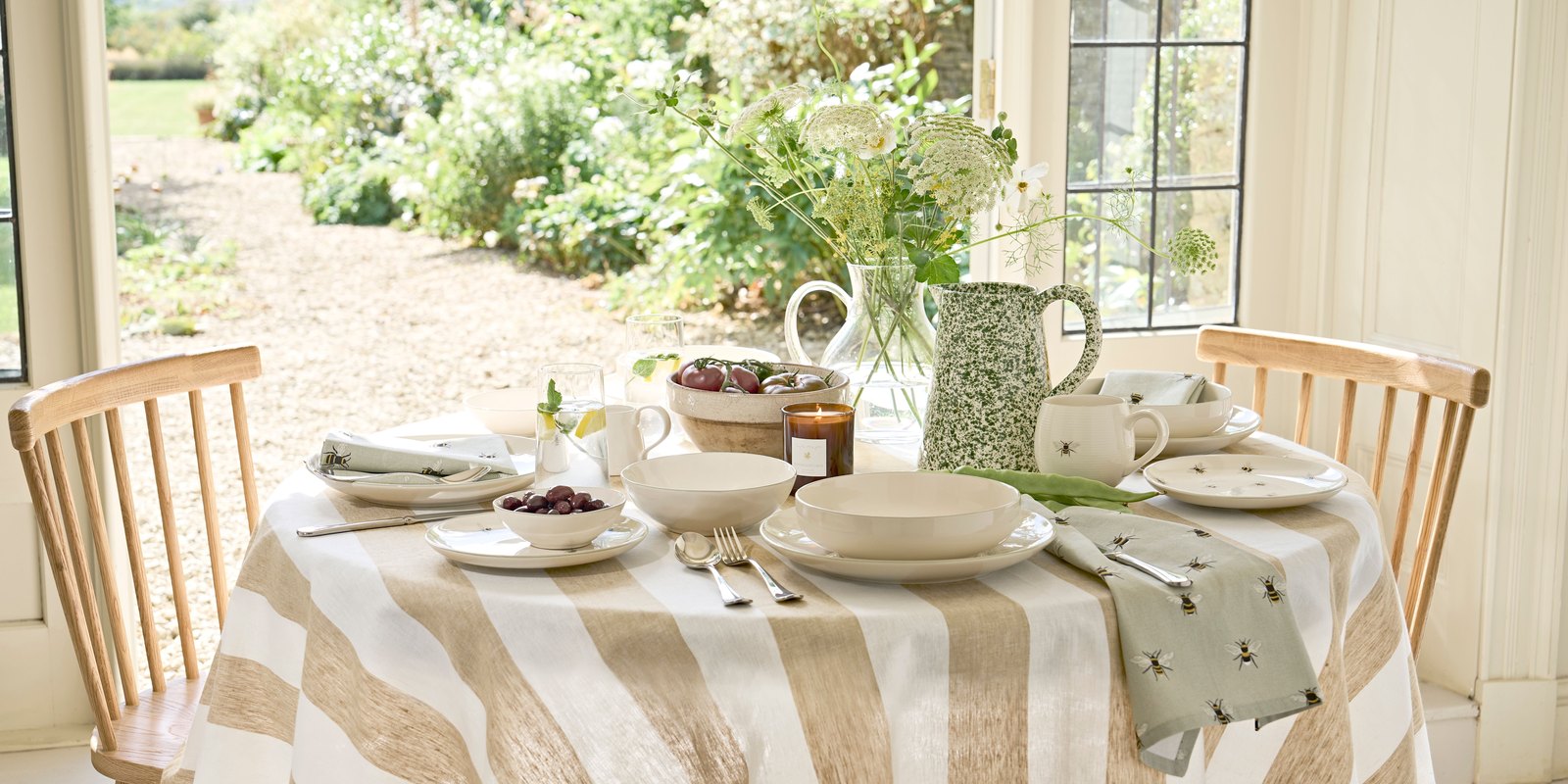
Soften the circle with a round tablecloth
The sand-striped cloth in this Sophie Allport photograph falls in relaxed folds around a round tabletop. It softens the edge and adds pattern while allowing the surrounding wood chairs and garden view to stay in focus.
To size any round cloth, add the drop on both sides: cloth diameter = table diameter + twice the desired drop. A 48 in (122 cm) table with a 10 in (25 cm) drop needs a 68 in (173 cm) cloth. Check the real chair arms and knees before choosing a longer drop. The pictured Sophie Allport Witham Sand Stripe Round Linen Tablecloth is listed at 190 cm (about 74.8 in) in diameter. The formula is a fitting method, not a measurement of the table shown in the photograph.