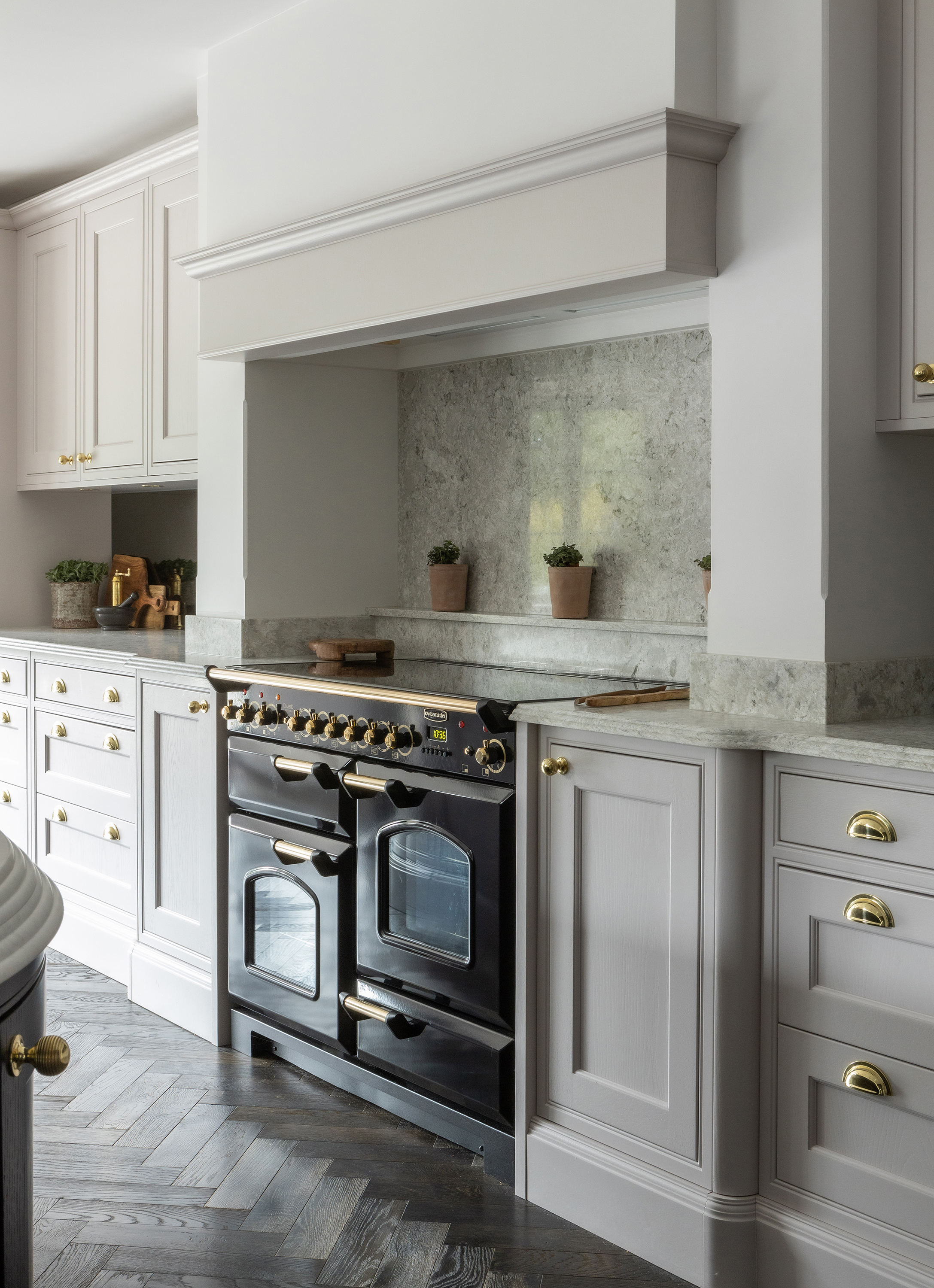
Make a painted hood feel like part of the cabinetry
In a traditional kitchen, a hood can disappear into the architecture without disappearing from view. Here the pale enclosure shares the paneled look of the cabinets on either side, and a deep, stepped molding finishes its lower edge. The black range with brass trim and the mottled stone-look backsplash make the cooking niche easy to read. The result is calmer than a freestanding metal chimney and more deliberate than a plain box on the wall.
Favor this approach when the cabinets already have meaningful trim: repeat the door profile and paint family instead of adding another finish at eye level. Make the surround wide enough to read as part of the cooking wall, but skip extra layers of ornament. With flat-front, minimal cabinets, a simpler enclosure makes more sense than borrowed period detail.
Because this painted surround conceals the working equipment, settle the insert or liner, duct path, access panel, and specified clearances with the installer before the cabinetry is built. For the surrounding doors and trim, Kitchen Cabinet Ideas explores cabinet profiles in more detail.
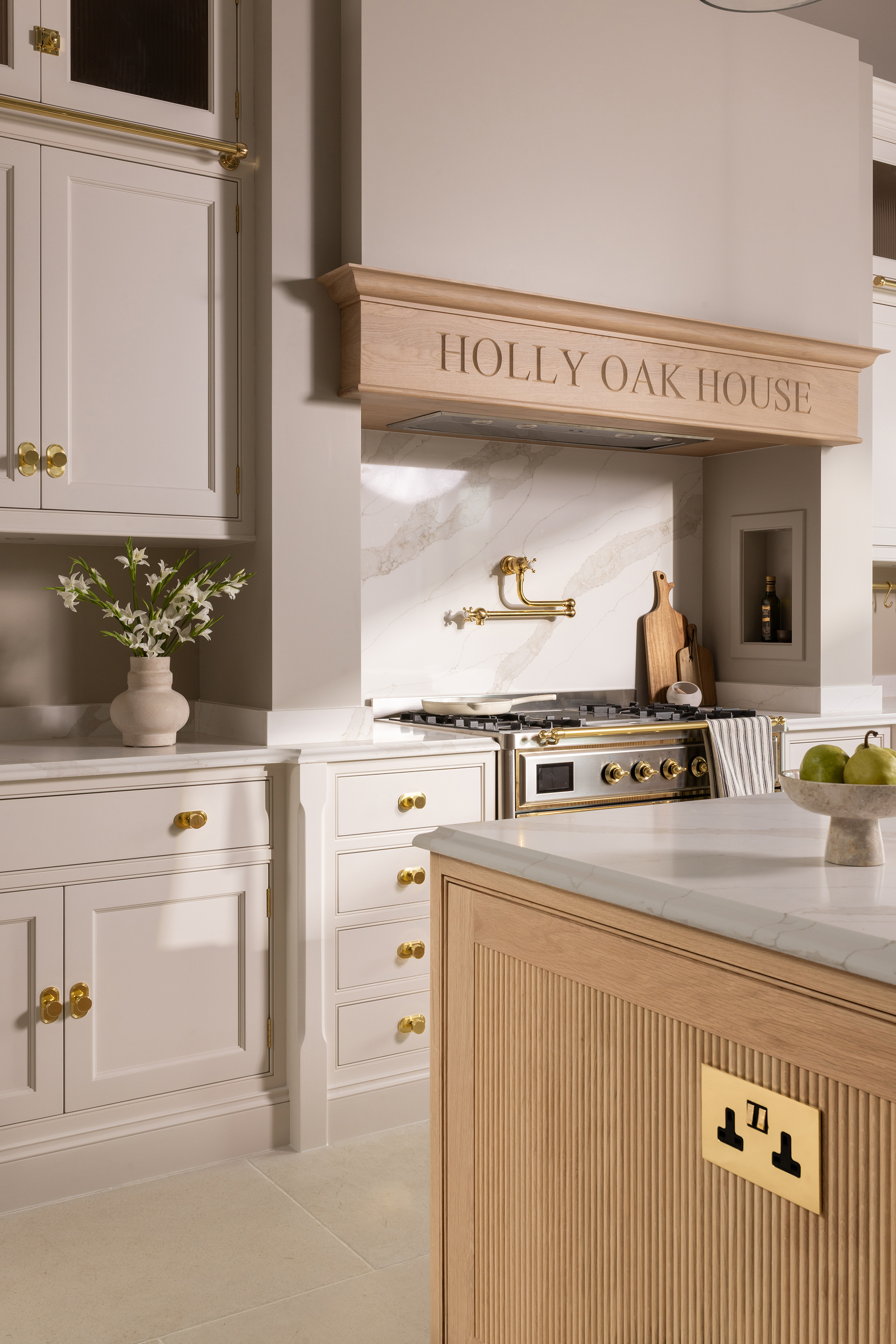
Give a custom hood a mantel-like ledge
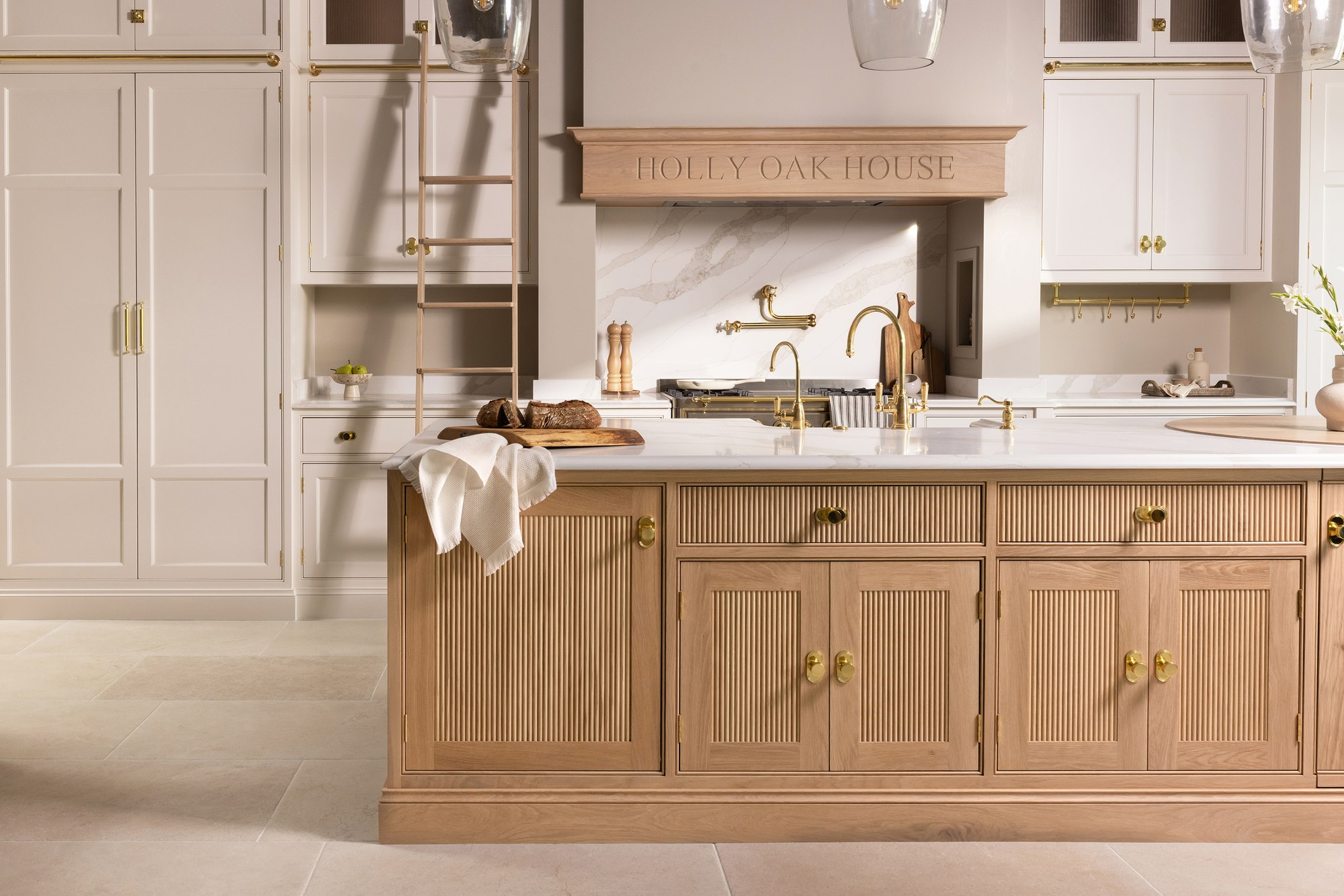
A horizontal wood rail changes the whole character of this pale hood. Instead of blending into the cabinets, the surround reads like a shallow fireplace mantel: a framed destination above the range. The lettering on the rail adds personality, but the more useful move is the contrast between the light-toned wood ledge and the taller, softly tinted housing above it.
A mantel-style canopy earns its space in a kitchen with traditional cabinetry, where a strong cooking center can balance an island or a bank of tall storage. In a narrow room, keep the ledge slim; too much projection crowds the wall. Lettering is optional, and a plain rail draws the same horizontal line without turning the hood into a sign.
A wood ledge near the range must be designed around the specified insert and its heat and clearance requirements; agree on those details before ordering the surround.
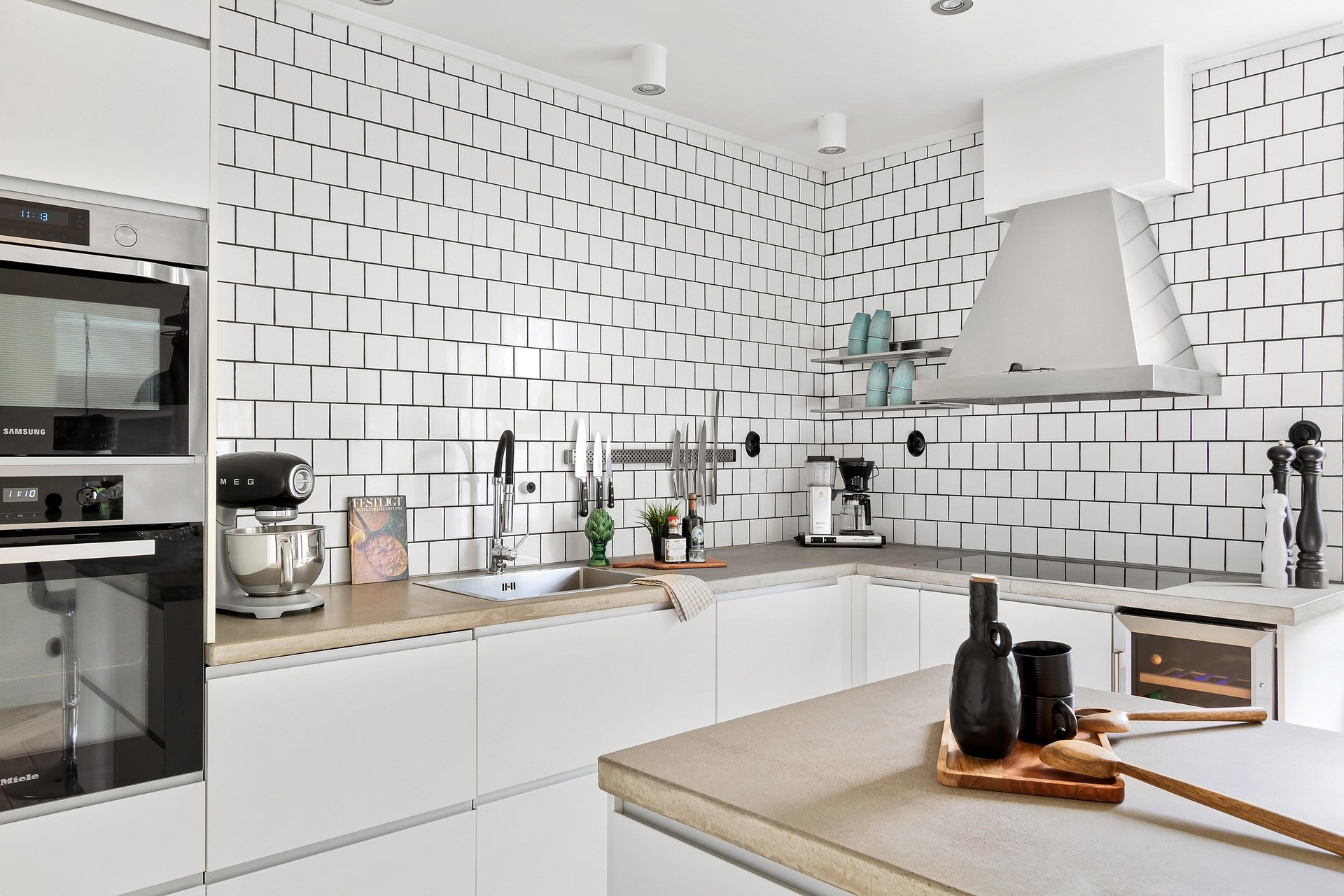
Let a white chimney echo the tile instead of competing with it
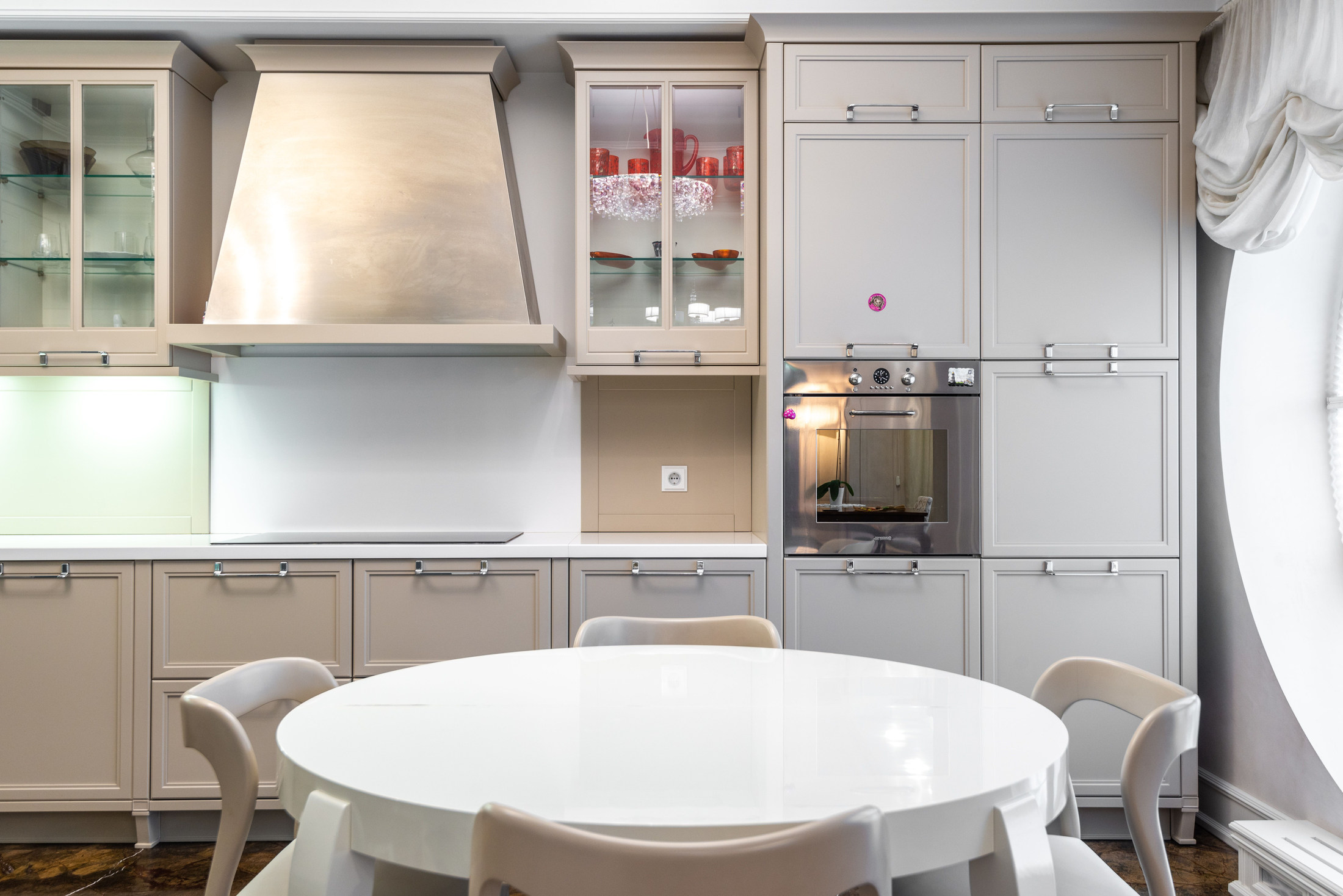
Dark grout draws a strong grid across this white tile wall. A pale, tapered hood stands out by its angled outline, yet its color keeps the wall from collecting another strong accent. A small open shelf and a few black accents give the eye enough contrast without asking the hood to be shiny or dark.
This works when tile is already doing the decorative work. If the backsplash has an obvious pattern, a plain hood gives it room; if the cabinets and walls are very quiet, the same shape can feel almost architectural. Compare it with the painted surround in Idea 01: one accepts the appliance silhouette, the other disguises it as cabinetry. Neither is automatically better, and the cabinet layout decides much of the answer.
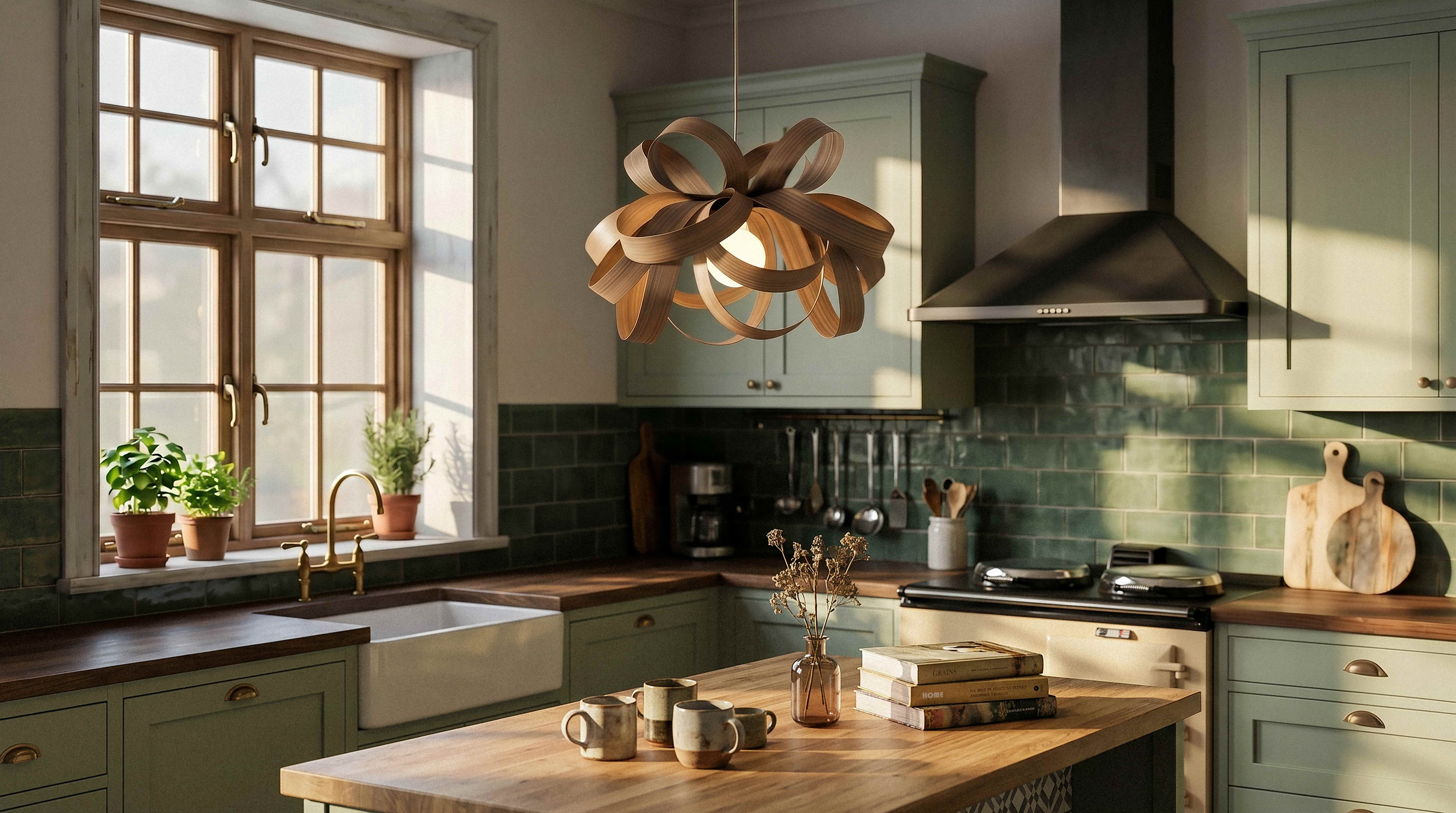
Use a black canopy as the dark note in a green kitchen
Muted green cabinets and deeper green tile could make this cooking wall feel saturated. The black canopy gives it a focal point, rising from the range in one clean stroke while the wood counter and a sculptural wood pendant bring softer texture into the room. The hood doesn’t have to match every handle, light, or accessory to belong.
Choose this contrast when you want colorful cabinets to stay the main event but need the cooking zone to read clearly. Against light tile, a dark hood looks graphic; against green tile, as here, it feels more grounded. Keeping the rail and trim around it quiet stops the black form from competing with too many other outlines. The pendant belongs to the same composition, but it is no substitute for ventilation over the range. For the broader palette, see Green Kitchen Ideas.
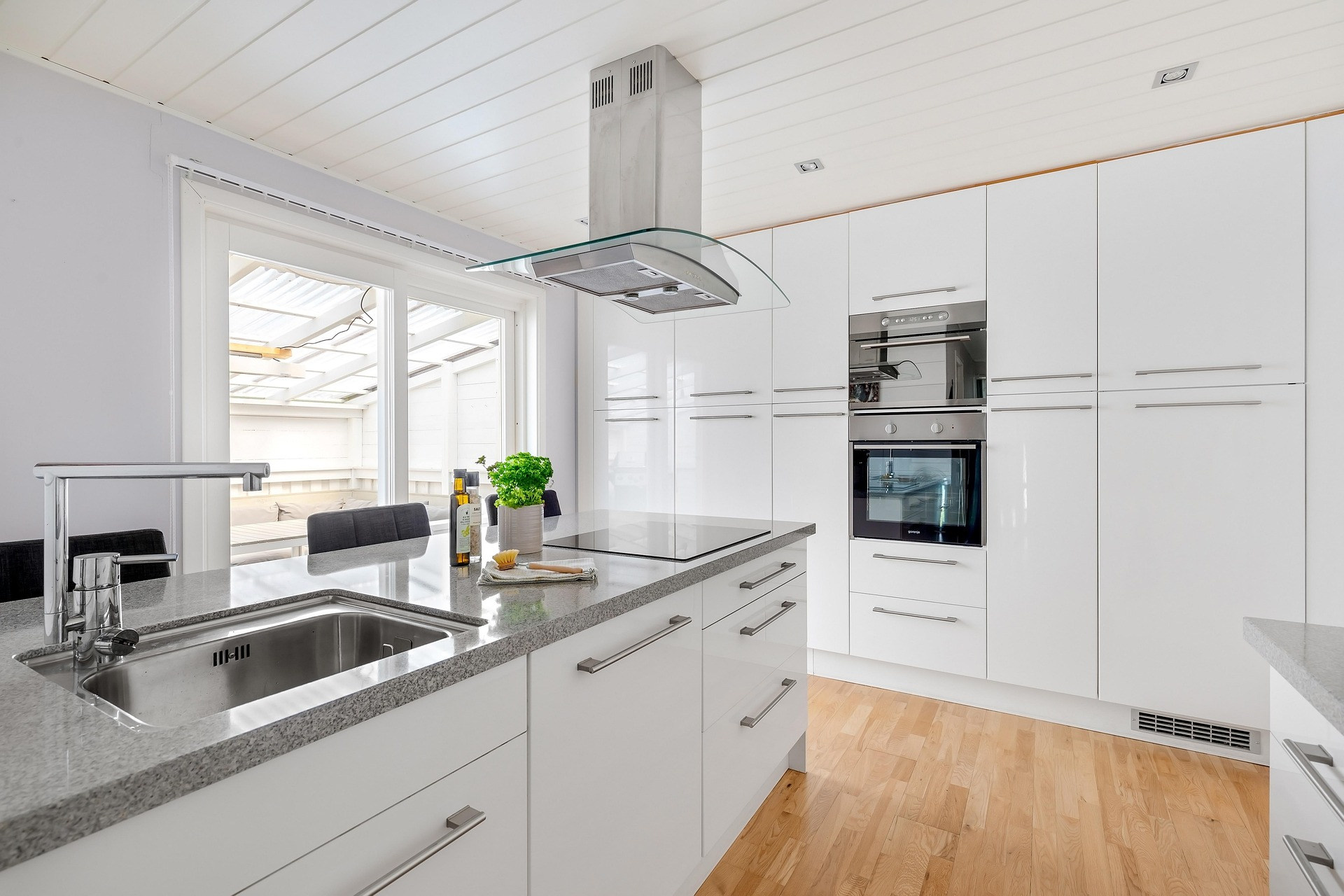
Keep an island hood visually light with a glass edge
An island cooktop changes the problem. The hood is seen from every side and hangs in the middle of the room instead of against a wall. In this bright kitchen the stainless chimney is clearly present, but its curved glass canopy leaves more of the cabinetry and windows in view than an opaque hood of similar width would. The glass edge does the visual work.
This is a useful compromise if you want a conventional overhead hood without a heavy-looking feature floating over the island. The glass won’t make the hood disappear, so judge the shape from the dining side as well as from the cook’s position, and draw the layout around the cooktop rather than the nearby sink.
Because the unit hangs in the open, verify ceiling support and the manufacturer’s mounting requirements before selecting the canopy. A glass edge changes the sightline, not the hood’s performance.
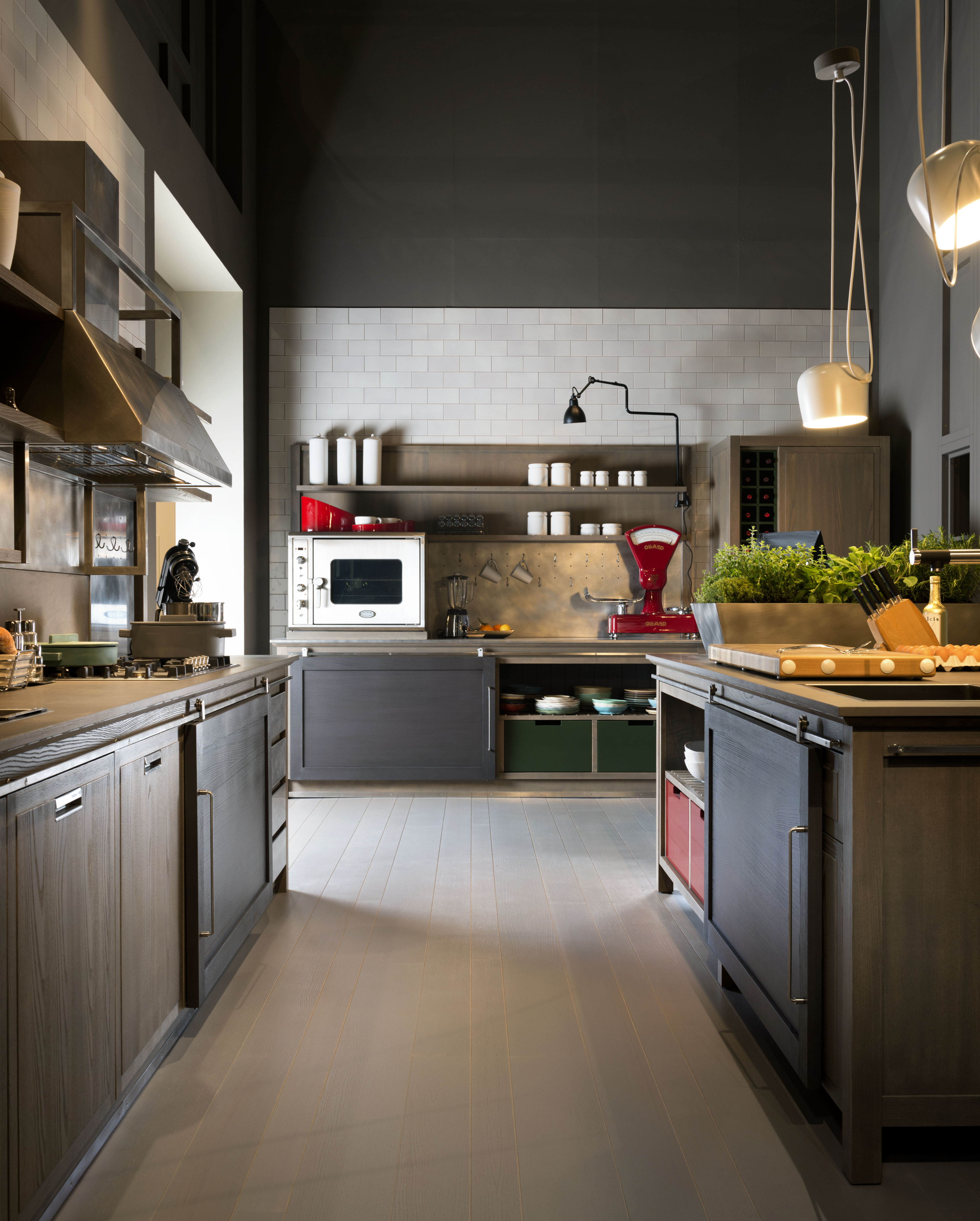
Let the hood borrow from an industrial palette
In this high-ceilinged industrial kitchen, the camera catches only the side of the metal canopy at left, not the whole hood. Its warm, aged-looking surface fits the metal-framed shelves, dark cabinet fronts, and workmanlike counters. Pale floorboards, white tile, and a small white oven on the back wall break up the darker palette.
The idea is to let the hood belong to an existing family of working finishes rather than treating it as an isolated showpiece. Compare a proposed metal sample with shelving brackets and cabinet hardware in the same light. Unlike Idea 12, where a black hood contrasts with white brick, this hood blends into a broader industrial composition. The photograph does not show the full canopy shape.
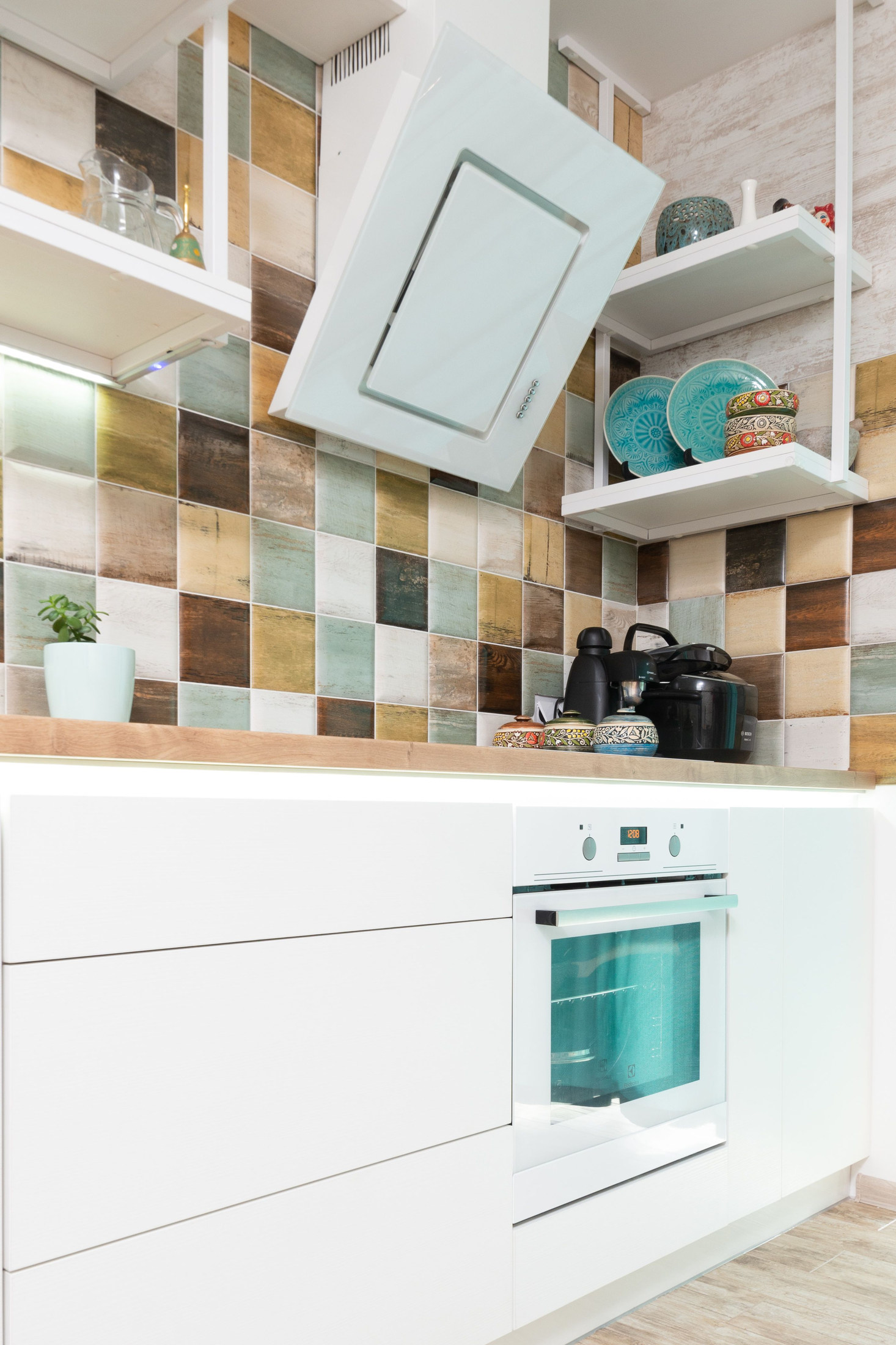
Choose a tilted pale hood to sharpen a colorful backsplash
A kitchen with a lively backsplash doesn’t need a featureless hood. This pale one leans out from the wall at a sharp angle, forming a crisp outline above mixed square tiles that carry most of the color. Because the hood stays light, its changing planes add interest without asking the eye to manage yet another saturated surface.
When the backsplash is busy, keep the hood’s shape clean and its finish close to the surrounding cabinets. Let one distinct angle carry the effect. A tilted hood can overpower a low ceiling or a tight run of upper units, so look at it beside the real doors and backsplash rather than alone on a product page. A side view is often more revealing than a straight-on elevation.
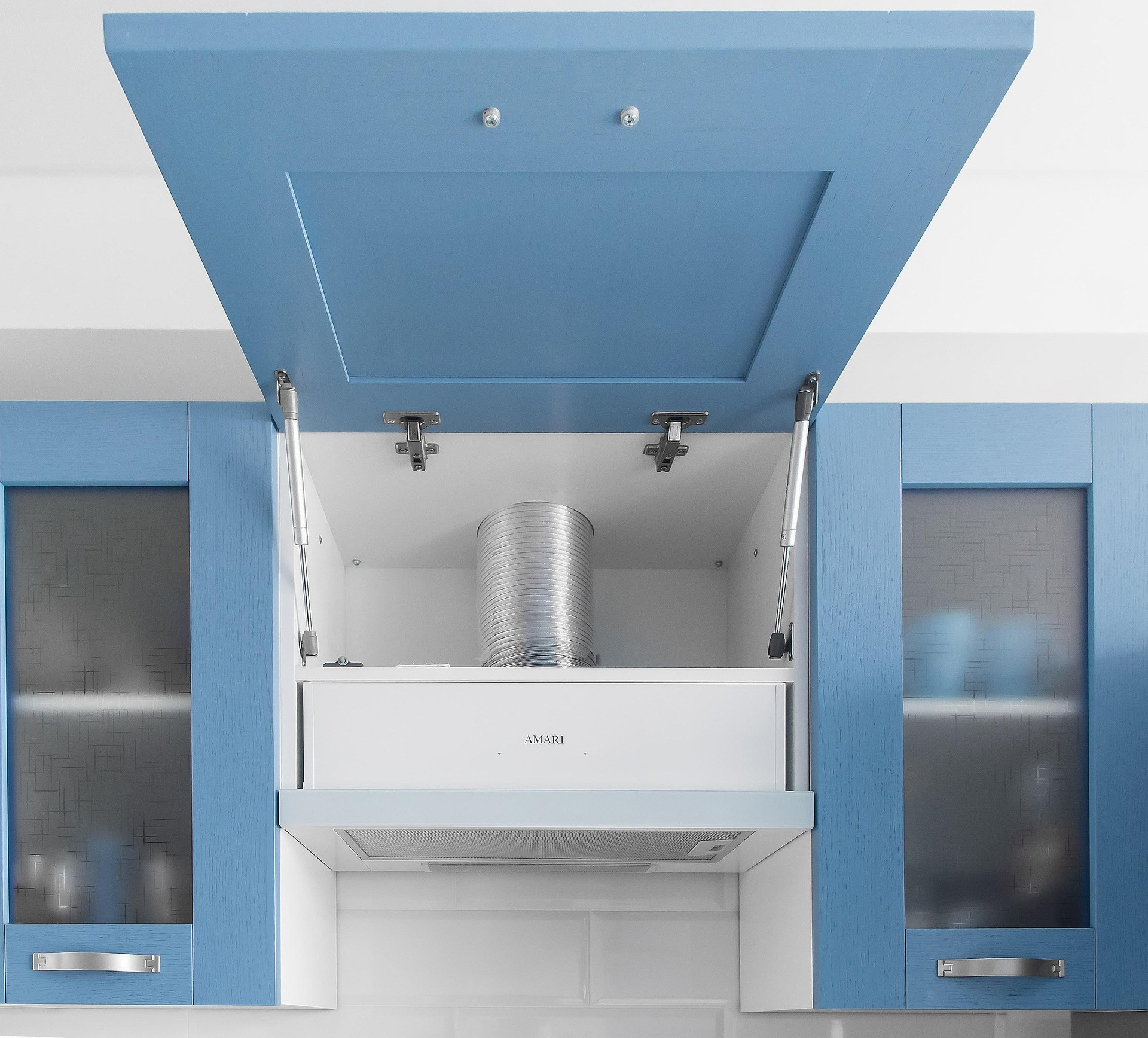
Look inside the cabinet before you hide the hood
The open blue cabinet in this photograph shows what a minimalist elevation usually leaves out. Behind the lift-up door sit a round metal duct, the cavity around it, and a slim built-in hood unit. The blue doors may make the ventilation feel discreet from across the room, but the equipment still takes up real cabinet space.
This is the most useful image to study before asking for a fully concealed hood. How much storage disappears? Can the filter come out without dismantling the cabinet? Where will the duct go, and can the lift-up door open without hitting the ceiling or the cabinets beside it? A clean front elevation means little if the unit can’t be fitted, cleaned, and serviced.
Have the cabinetmaker draw the chosen hood, duct route, and filter-removal space inside the cabinet before fixing the lift-up door height. This photograph shows space taken by equipment, not an approved installation drawing.
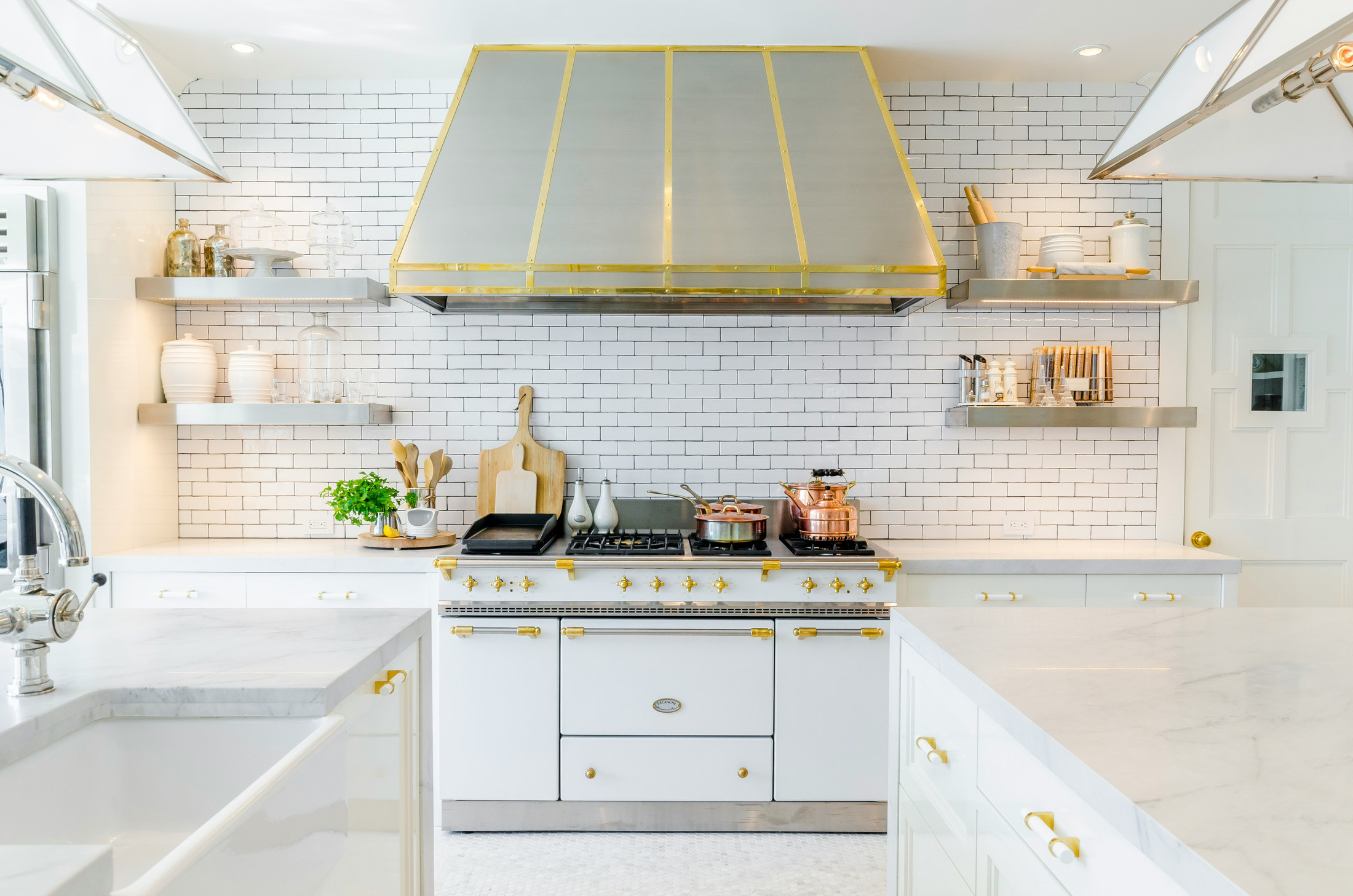
Let a brass-banded hood be the expressive finish
In this mostly white kitchen, the broad, tapered canopy is the showpiece of the cooking wall. Its brushed-metal-looking panels are outlined in brass-colored bands, a warm detail that catches the eye without a dark block of color. Pale cabinetry, white tile, and a white range with brass trim give it the room to make a statement.
A hood like this suits a kitchen where you want one material to change the mood. The warm-colored bands can echo a faucet or handles, but every piece of hardware doesn’t need to match. Too many competing gold tones can feel busy, so repeat the warmth once or twice and let the cabinets stay the background. Compared with the black canopy in the green kitchen, this one stands out through brightness and detail rather than a hard silhouette.
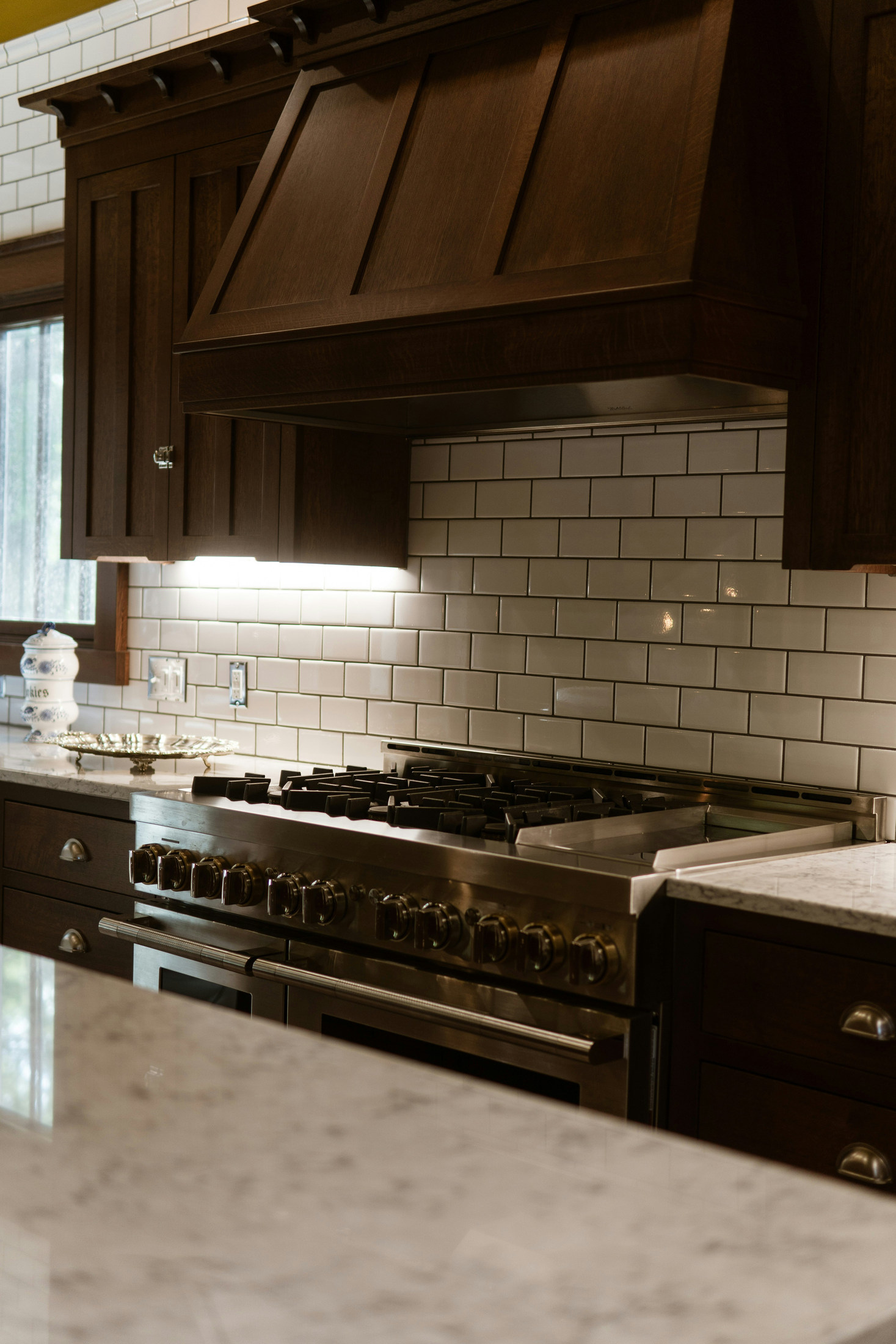
Frame the range with a stained wood surround
The broad, dark wood-finished hood surround in this kitchen feels more like furniture than an appliance cover. Its paneled front and large upper body connect to the darker cabinetry, while the glossy pale tile behind the range keeps the whole wall from getting heavy. The professional-style stainless range stays fully visible below.
A wood-finished surround is worth considering when painted cabinets feel too plain and another exposed metal chimney would interrupt traditional materials. The deeper the stain and the bigger the enclosure, the more visual weight it carries, so balance it with a simpler backsplash and plenty of lighter surface below. If the kitchen already has many dark upper cabinets, a smaller wood rail may do the job better than a full wood-clad hood.
For a wood-finished enclosure, the insert manufacturer’s shielding and combustible-material clearances determine how the look can be built. Confirm these requirements before the woodwork is fabricated.
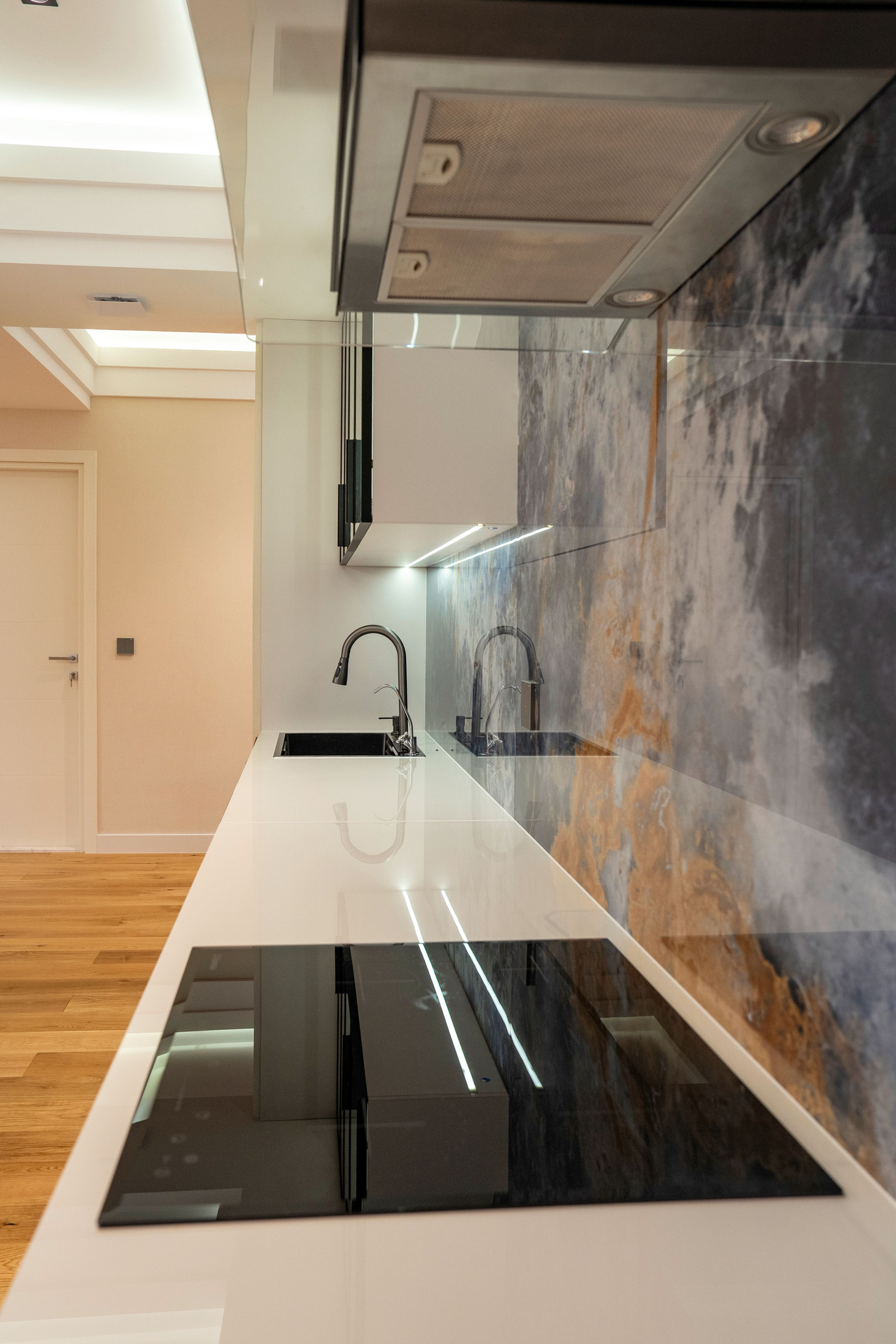
Keep the stone-look backsplash in view with an under-cabinet hood
The gray stone-look backsplash, streaked with rust and ochre, supplies the strongest pattern on this wall. The low-angle photograph also shows the large underside of an under-cabinet hood, complete with filters and lights. It is not a barely visible appliance. Instead, the hood occupies the upper edge of the composition while much of the veined backsplash remains exposed.
Choose this relationship when the backsplash carries enough color and movement to be the decorative feature. A bulky custom surround could conceal more of it, while an under-cabinet unit keeps the stone-look panel visible to the side and below. Study the hood from underneath as well as from the front: filters, lights, and its projection over the cooktop are part of the view you will live with.
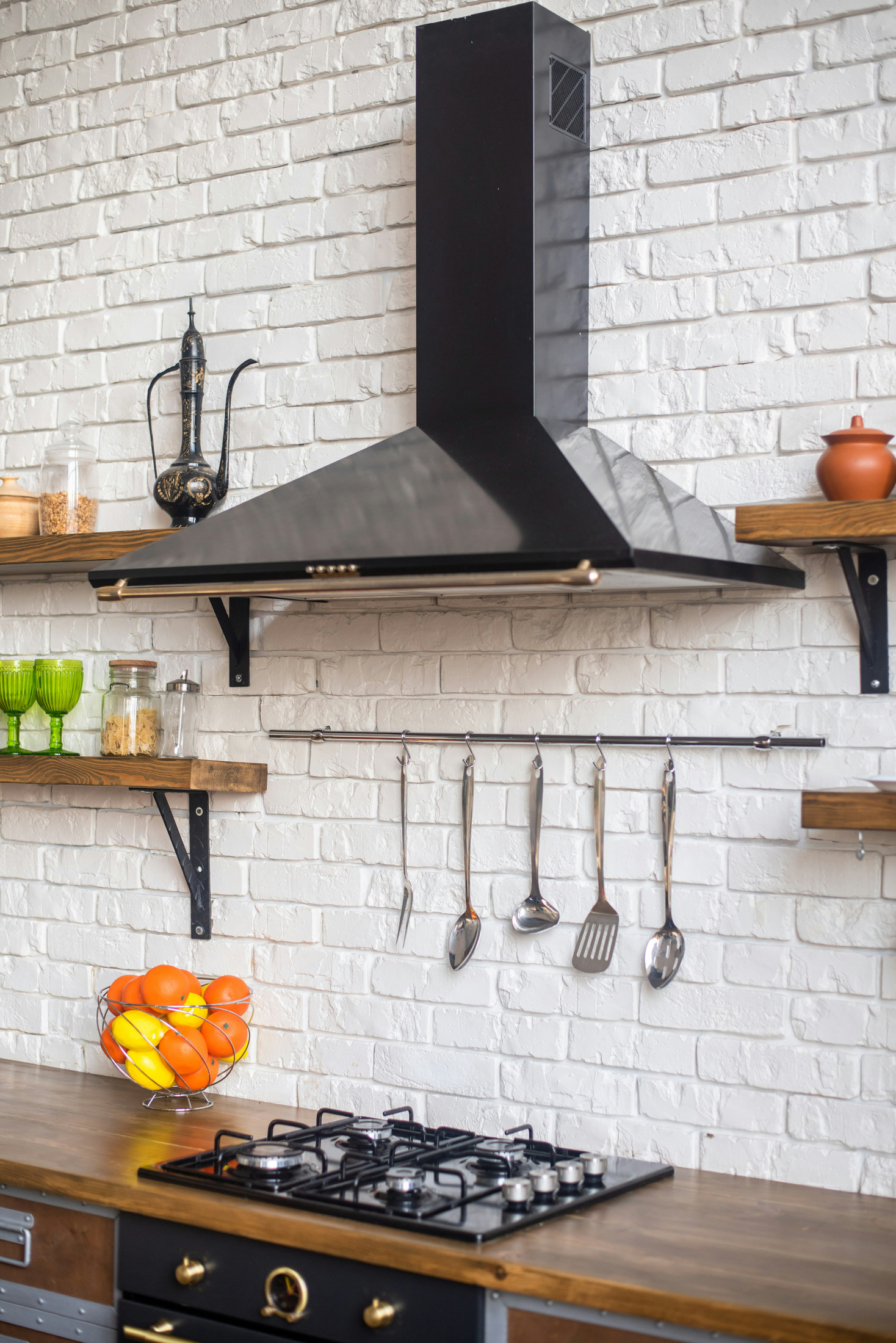
Set a black industrial hood against white brick
This black chimney hood looks sharp against a white brick wall. The irregular joints give the surface movement, while wood shelves on black brackets and a rail of simple metal utensils extend the workshop-like character of the cooking wall. Unlike the industrial kitchen in Idea 06, where the hood joins several aged-looking metal finishes, the interest here comes from contrast: a crisp black form against an irregular light background.
Where brick or another textured surface is already there, the most convincing hood is often the simplest. Let the angled canopy sit clearly above the cooktop, limit extra dark cabinets around it, and keep the shelves useful rather than heavily styled. If you’re finishing the wall new, think about how it will be cleaned near steam, grease, and splatter, because texture has a maintenance cost.
How to choose a kitchen hood for your room
First, decide whether the hood should blend with the cabinets, frame the range, or become the cooking wall’s main feature. A matching painted enclosure feels calm beside traditional doors; a mantel adds a horizontal focal line; an exposed black or metal-and-brass chimney announces the cooking area. For a prominent backsplash, a slim, quiet hood may leave the strongest material visible.
Then look at where you actually cook. Wall-mounted hoods, built-in inserts, and overhead island hoods solve different spatial problems. If the cooktop is on an island, check the view from every side and the route overhead. If it sits below upper cabinets, ask whether the design leaves room for the hood, its duct, and access to clean the filters. Read the manufacturer’s installation guidance before you commission a decorative shell or fix the surrounding cabinetry. Sketch the hood at its real scale alongside the cabinets before finalizing millwork.
Before you order the surround or hood
Confirm the ventilation route. A hood ducted to the outdoors and a recirculating hood are not equivalent. Whether the arrangement you want is feasible depends on your building and local requirements.
Match the hood to the cooktop. Compare the actual hood’s capture geometry, approved mounting position, and specified performance. An airflow number in CFM alone is not a guarantee of capture.
Design around the equipment. Coordinate the approved insert or liner, duct, cabinet cavities, electrical access, filters, controls, and maintenance needs before final millwork drawings.
Review clearances and materials. The exact appliance and the locally adopted rules govern installation. Never copy a distance or a combustible-material detail from an inspiration photograph.
Think about daily use. Check the selected unit’s noise information, lighting, control placement, and cleaning instructions rather than assuming every hood of the same shape behaves alike.
For a range hood that vents outdoors, the U.S. Environmental Protection Agency advises turning it on whenever you cook and leaving it on for 10–20 minutes afterward. Where outdoor-venting ventilation is unavailable, EPA outlines supplementary ventilation and filtration measures. Good ventilation is a practical requirement; the design choices above help the equipment belong in the room.
Further reading: U.S. EPA cooking-air guidance · Broan-NuTone range hood considerations · Consumer Reports range hood buying guide