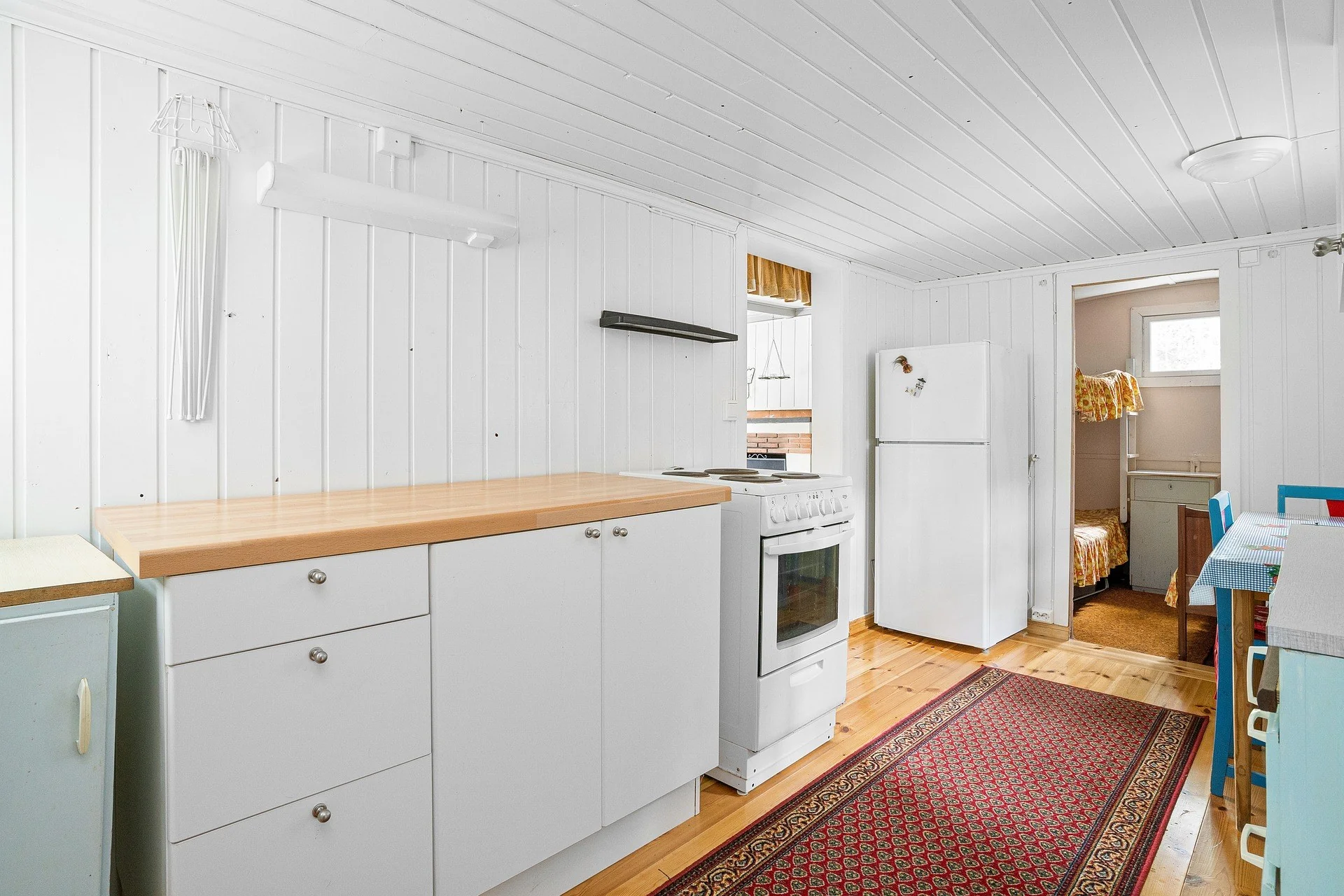
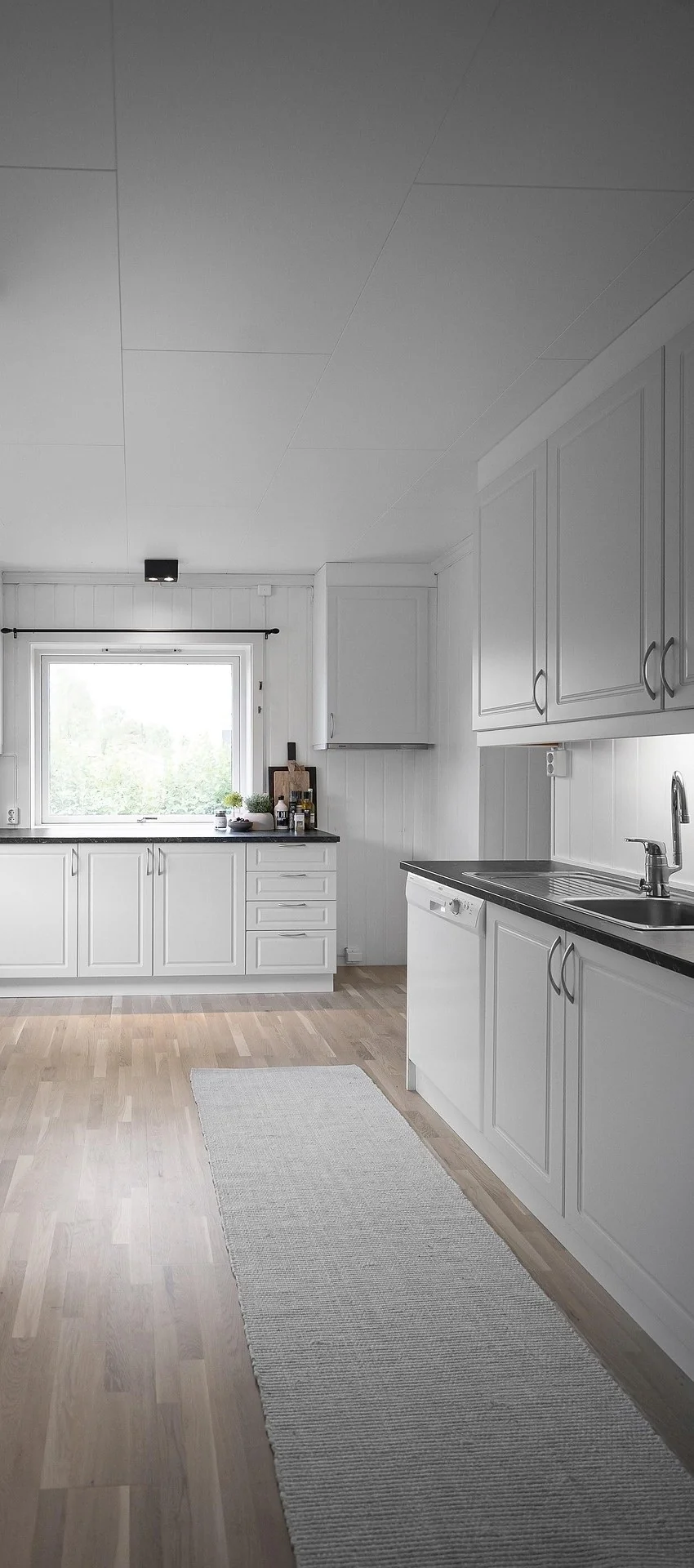
One runner can make a galley feel continuous
A long galley invites a runner. A compact U-shaped kitchen may need only one small rectangle or round rug. A dining table needs a wider footprint that still works when someone pushes back a chair. Use the photographed ideas below to choose a shape first; the style can follow.
A narrow kitchen aisle already reads like a corridor. In the tall white kitchen below, one gray runner draws the eye from the near floor toward the window. Several smaller mats would break up that line and add more edges to catch a foot in a busy route.
Measure the usable aisle between cabinet fronts—or between a cabinet run and a wall—not the width of the room. Open the dishwasher and any low-swinging doors as you test: a runner that looks well centered with everything closed may catch once the kitchen is in use. Leave floor showing along both sides. Where a door skims the surface, look for a thin, low-profile rug rather than a deep pile.
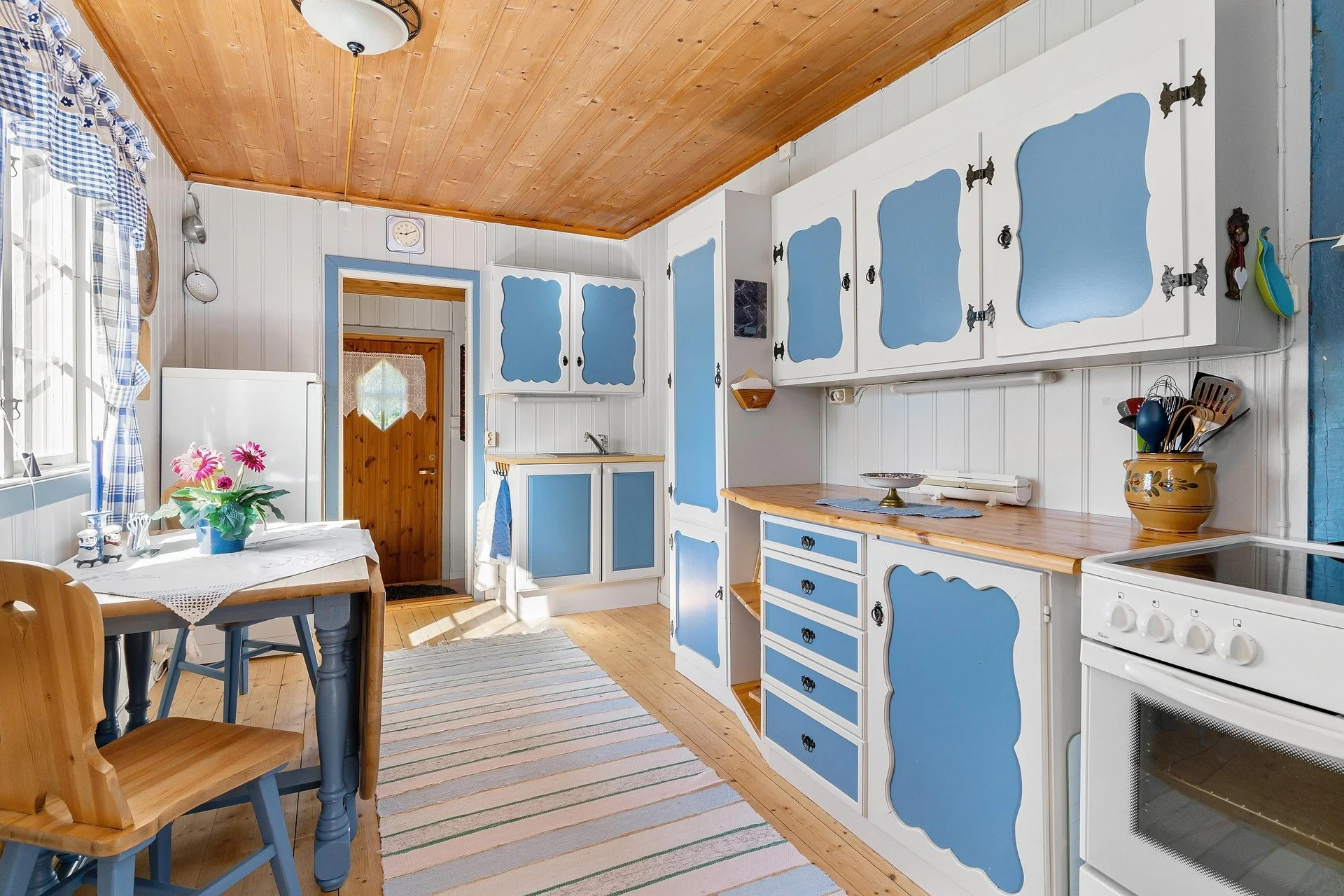
Let quiet stripes connect a cottage kitchen
Painted blue-and-white cabinet fronts, wood on the ceiling, and a striped floor textile give this cottage kitchen several layers of detail. The rug earns its place by being quieter than the doors. Its pale, soft stripes carry muted color across the floor without competing with the shaped panels.
In a kitchen with decorative cabinetry or a busy backsplash, borrow one subdued hue rather than matching every color. Soft stripes work especially well when the room already has larger, stronger forms. Judge direction and scale in your own space: a tiny stripe that looks calm on a product page can turn busy over a long run.
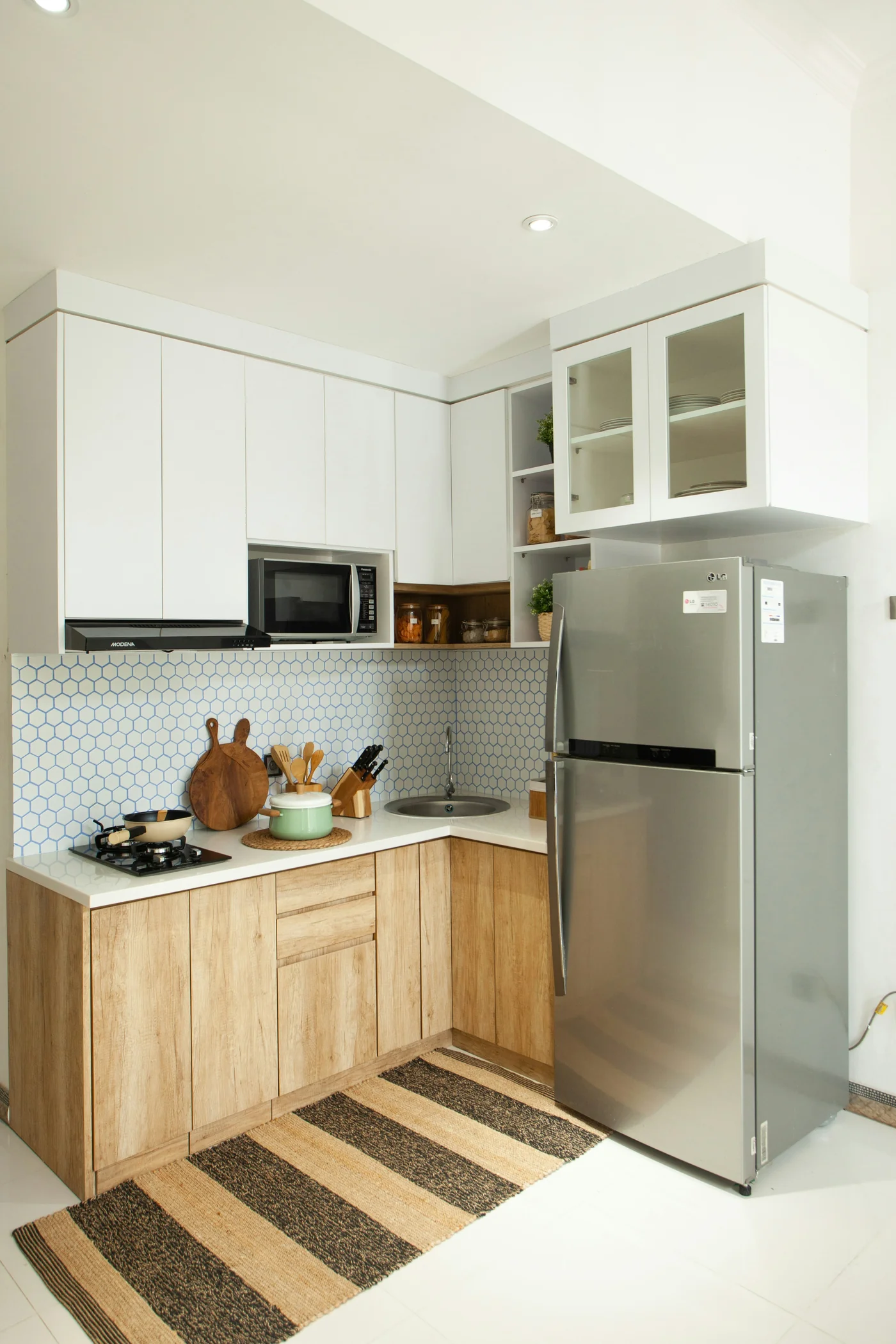
Stop a kitchenette rug where the work run ends
The white uppers and wood lower cabinets in this small corner kitchenette need a shorter answer than a full-length galley runner. Here, a compact striped rug lies in front of the base cabinets and stops beside the refrigerator, so most of the floor stays open. Its dark bands pick up the contrast between the pale floor and the wood cabinetry.
For a one-wall or corner layout, measure the usable standing stretch, not the entire wall. A rug that reaches an entry, a refrigerator door swing, or the spot where a stool pulls out is doing too much. Watch the refrigerator in particular: the rug here ends right beside it, so check that the door opens without catching the edge. If your kitchenette has only one genuine work station, a short mat often feels more intentional than a long runner bought to fill empty floor.
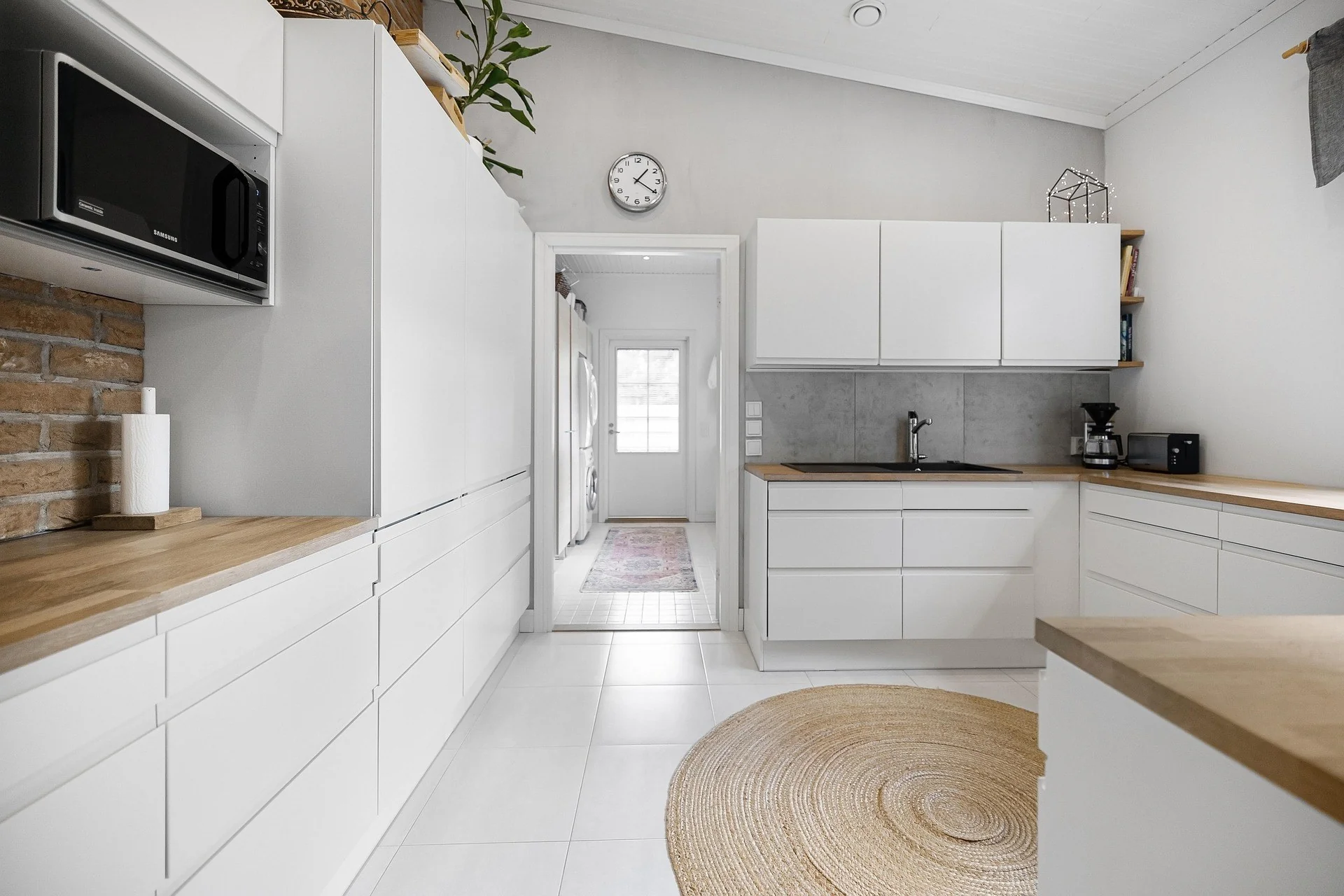
Use a round rug for one open spot
A natural-colored round rug sits on the white tile of this bright kitchen and softens all the straight cabinet edges around it. Because the rug is compact, most of the floor stays exposed. Its rounded outline gives the eye somewhere to rest without crowding the middle of the room.
A round or oval rug works best when it serves one station—perhaps the sink or a small prep area—rather than a continuous walking route. Near splashes, look for a rug designed for that setting and a nonslip system that suits both the rug and the floor. The woven look here is a style cue, not evidence of a particular fiber or of washability.
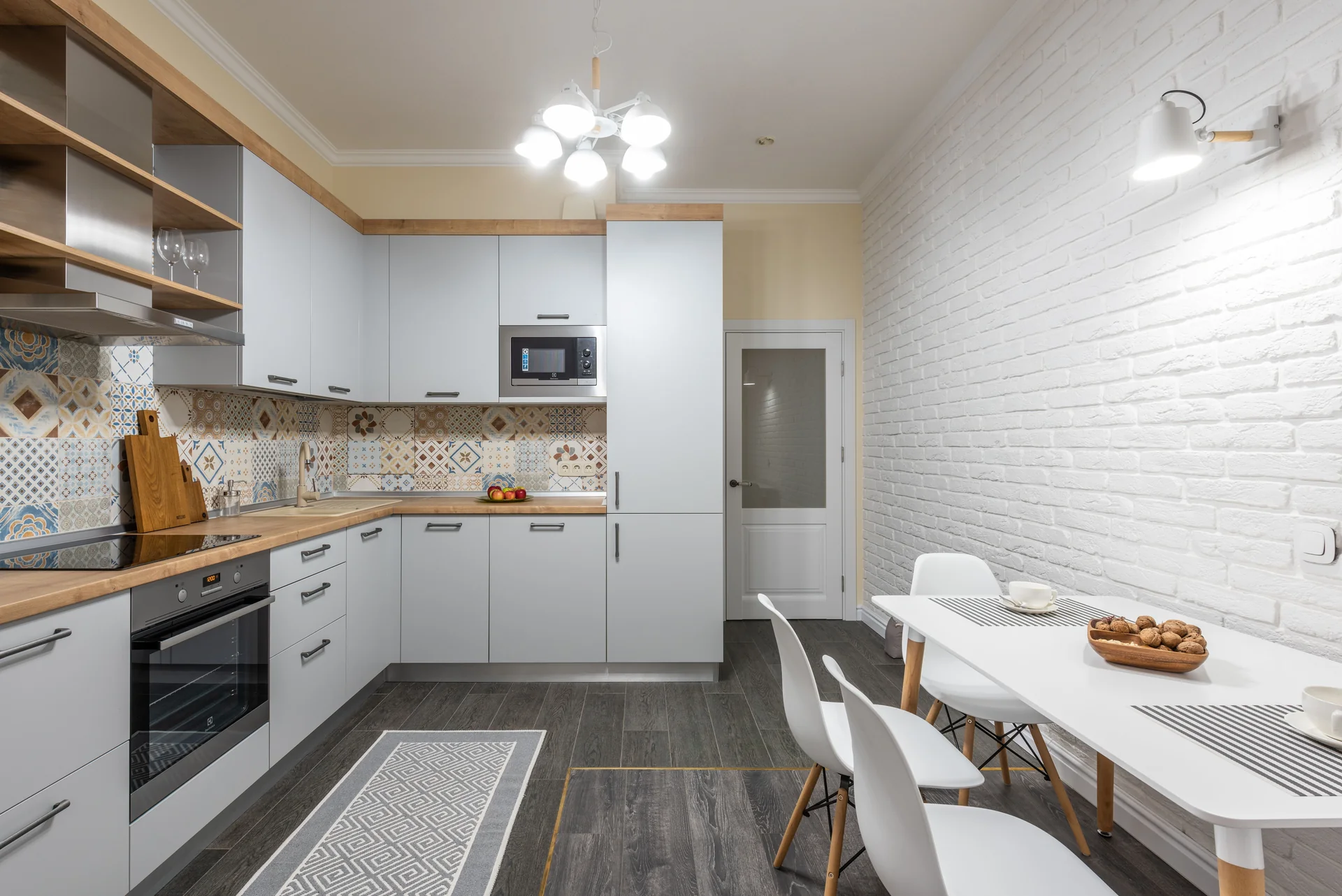
Give an L-shaped kitchen a quiet rectangle
In this L-shaped kitchen, a pale gray runner with a fine border sits alongside the cabinetry, while the dining table occupies the open side. The rug defines the working floor without extending beneath the dining furniture.
Choose a rectangle when its corners can lie flat beside the cabinet run and there is still a clear route toward the table. Compared with the round rug above, the rectangle defines a straighter working strip; the round shape softens a single open spot. Before buying, open the dishwasher and drawers and check that the rug stays outside their sweep.
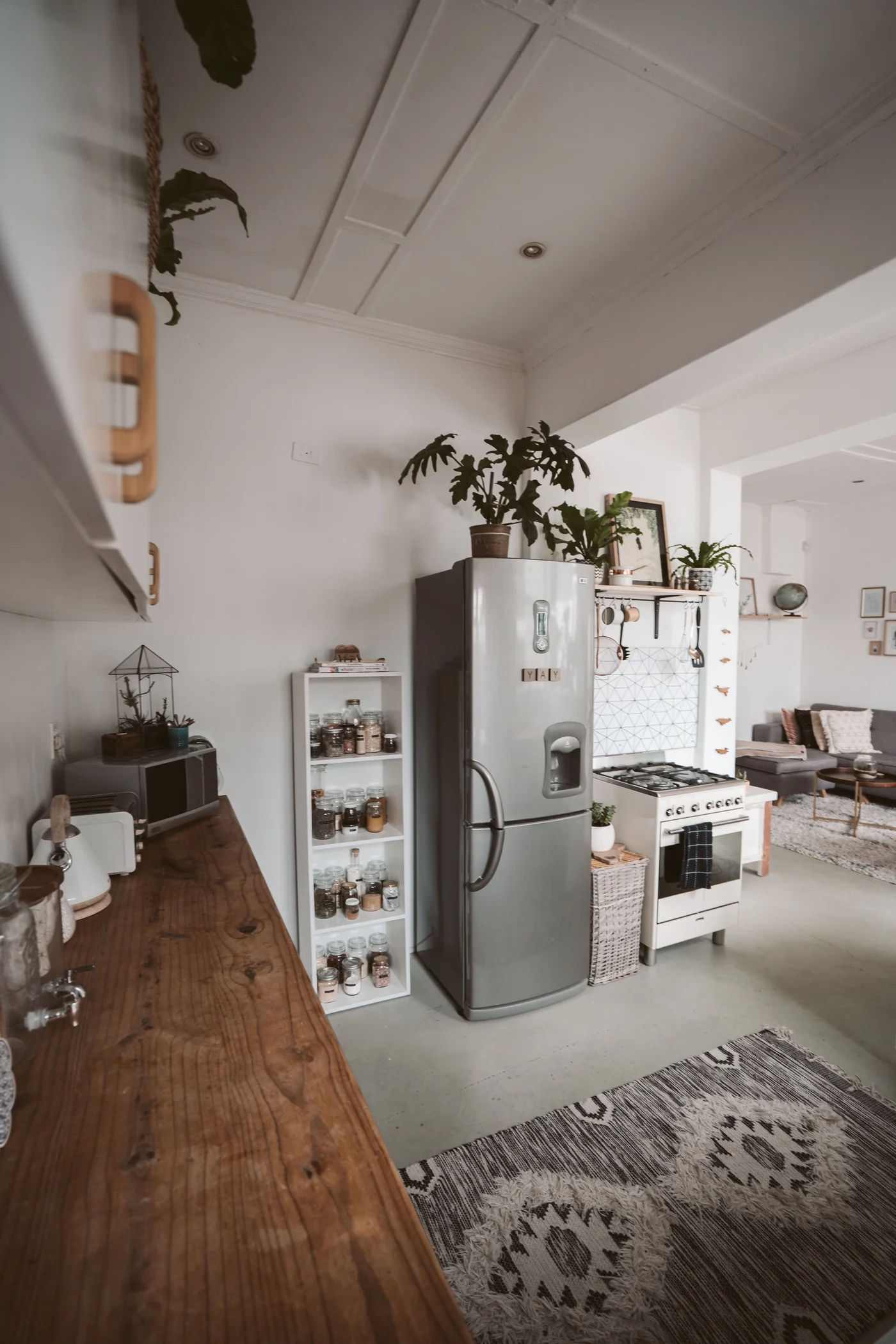
Choose a traditional pattern for character, not an heirloom headache
A rug is often the simplest strong accent in a room of fixed finishes. The red runner at the start shows one approach: one vivid patch of color against pale cabinets. The photographs below offer alternatives, from worn-in traditional patterns to quiet tone-on-tone texture.
A wood counter, a small open shelf, and pale walls make an easy backdrop for the charcoal-and-cream geometric rug in this kitchen. The busy textile adds a sense of age without antique cabinetry or another patterned wall, and its limited palette keeps the room relaxed rather than ornate.
A vintage look and a vintage textile are different purchases. For a floor that sees cooking splashes, a washable vintage-style reproduction may be more sensible than a delicate original. Check the care label, backing, and machine-size instructions for the exact rug; “washable” doesn’t automatically mean every size fits a home washing machine. Keep an irreplaceable piece for a spot less prone to spills.
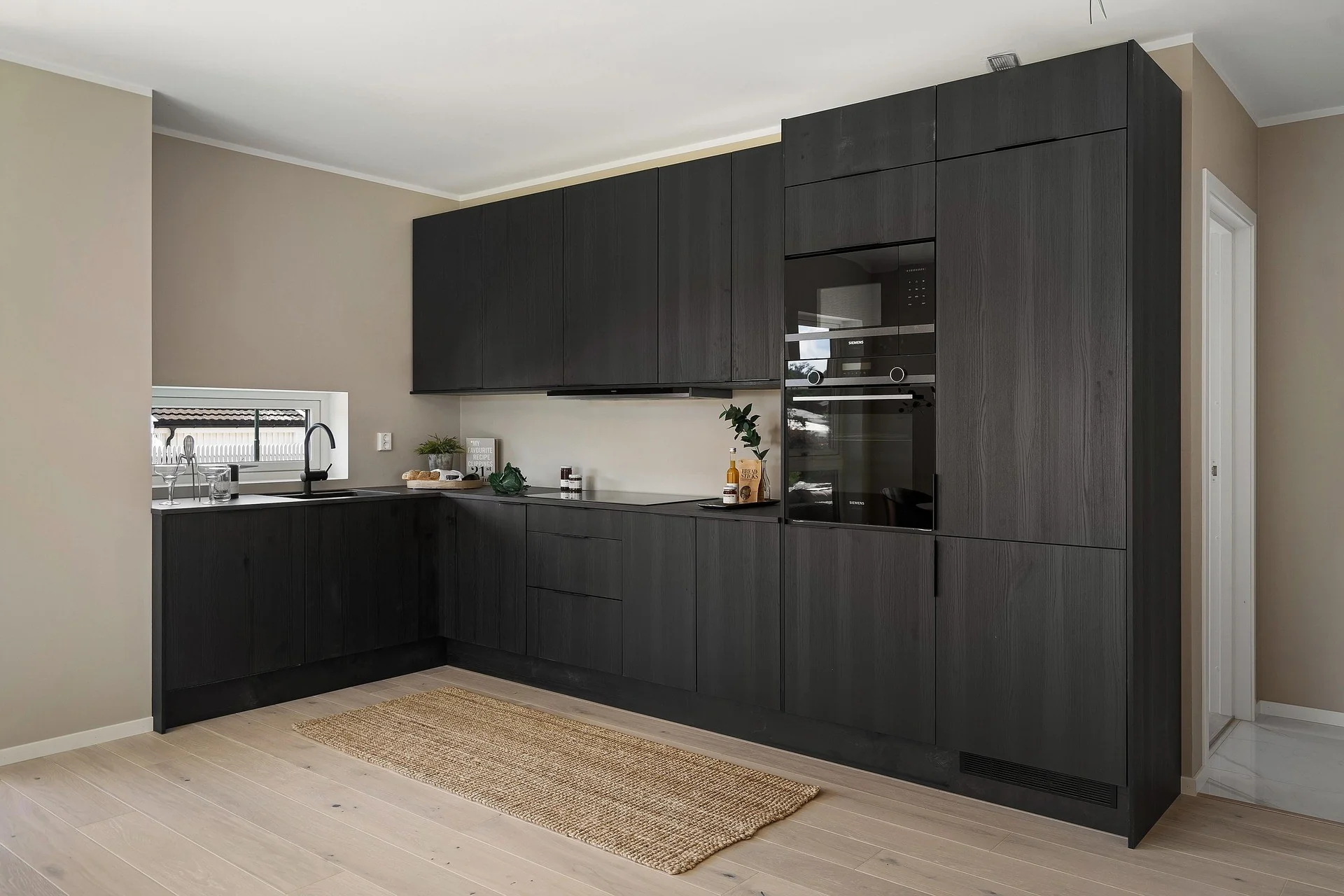
Balance dark cabinets with a lighter woven look
A broad beige rug sits in front of a long wall of charcoal cabinetry here. The high contrast makes the floor easy to read and prevents the dark doors from becoming the only large visual surface. The woven-looking texture adds warmth without a second bright color.
This is a strong direction for black and deep-gray kitchens, particularly when the floor itself is pale. But don’t buy on looks alone: a jute-look synthetic and a true natural-fiber rug can behave differently around water. In a sink run that gets wet often, put the product’s cleaning and drying requirements first. In a drier spot, a more textured natural material may be worth the extra upkeep.
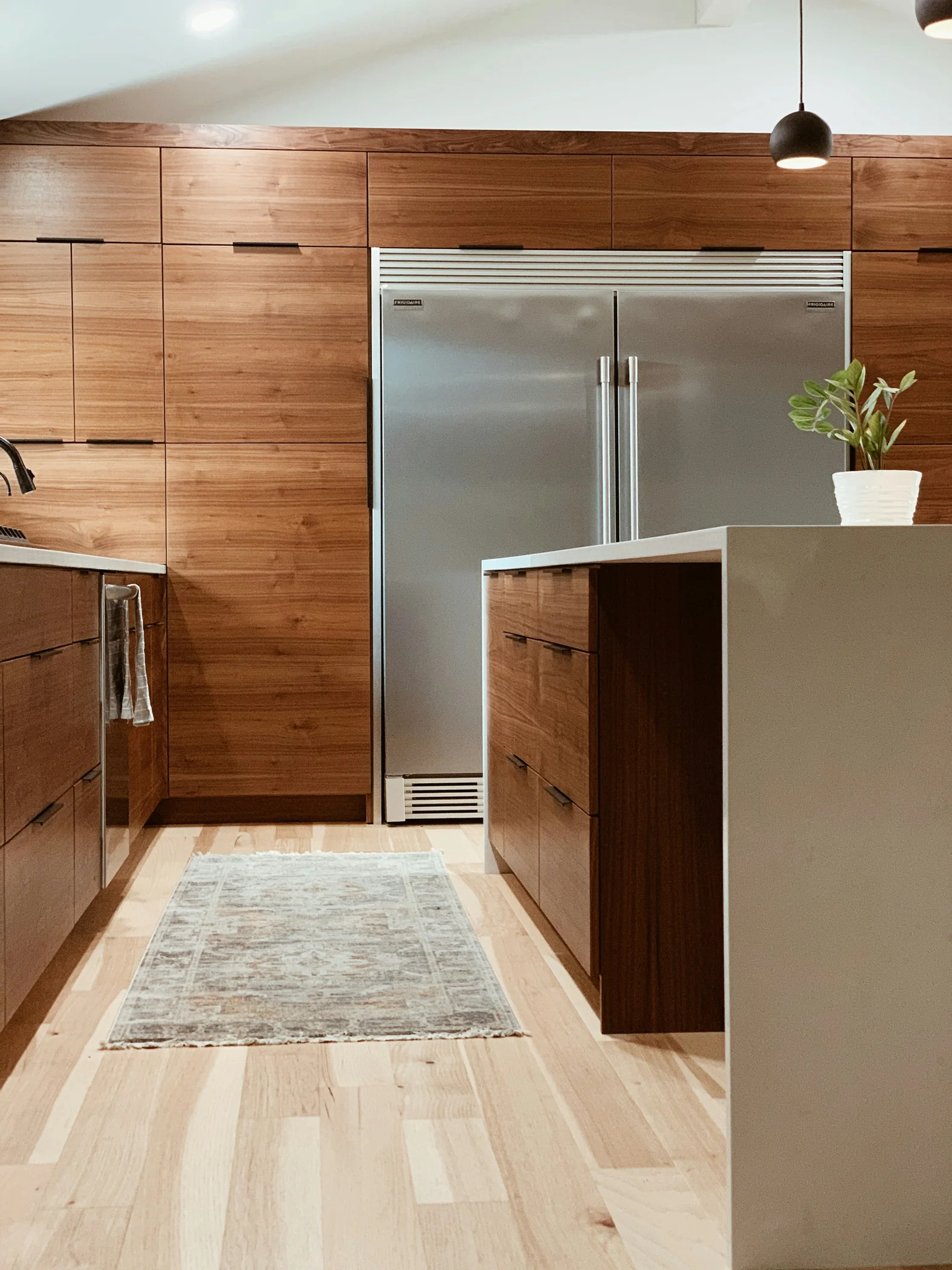
Let a faded runner soften rich wood cabinetry
Dark, richly grained wood cabinetry is already a major part of this room’s character. A faded blue-gray runner beside the island adds softness and a little age without asking for attention: its low contrast against the light wood floor keeps the pattern quiet.
For a quiet kitchen, look for a rug a shade lighter or darker than the floor rather than an exact match, so the texture reads and the edge doesn’t disappear. If this is a damp work aisle, make care and grip the deciding factors after color.
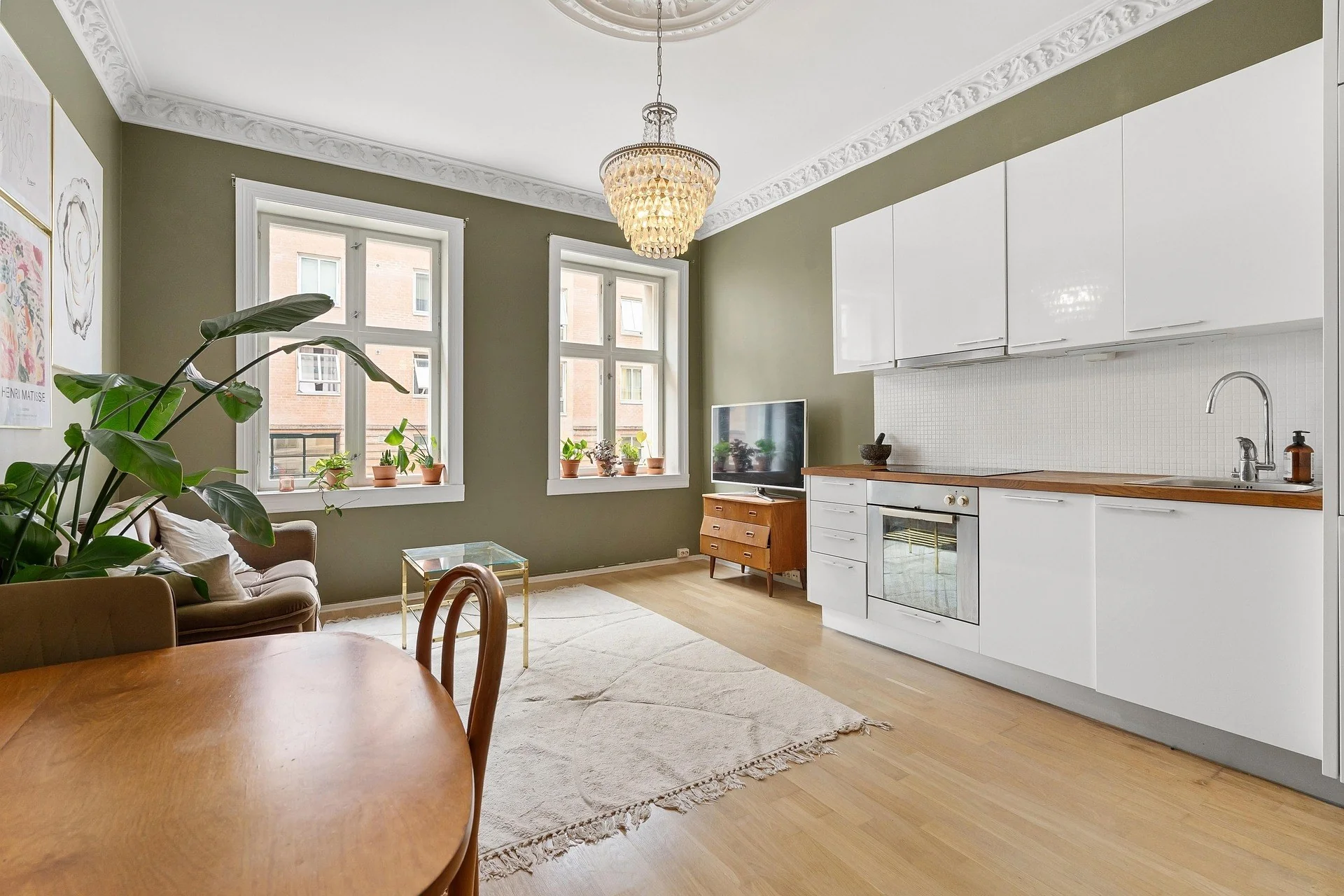
Let a soft cream rug bridge green walls and white cabinets
An olive-green wall, glossy white cabinets, and a warm wood worktop already give this kitchen several colors to balance. The cream rug in the open living area beyond doesn’t try to match the green. It works as a gentle neutral against both the walls and the cabinets, helping the room feel considered without adding another saturated accent.
This is useful in sage, gray-green, or soft olive schemes when a green rug would feel too literal. It also suits a kitchen that runs straight into a living area, as here. Hold samples next to both the wall color and the flooring: a cream can look yellow beside olive, and a gray can look blue beside warm wood. The photo supports a color direction, not an exact paint or textile identification.
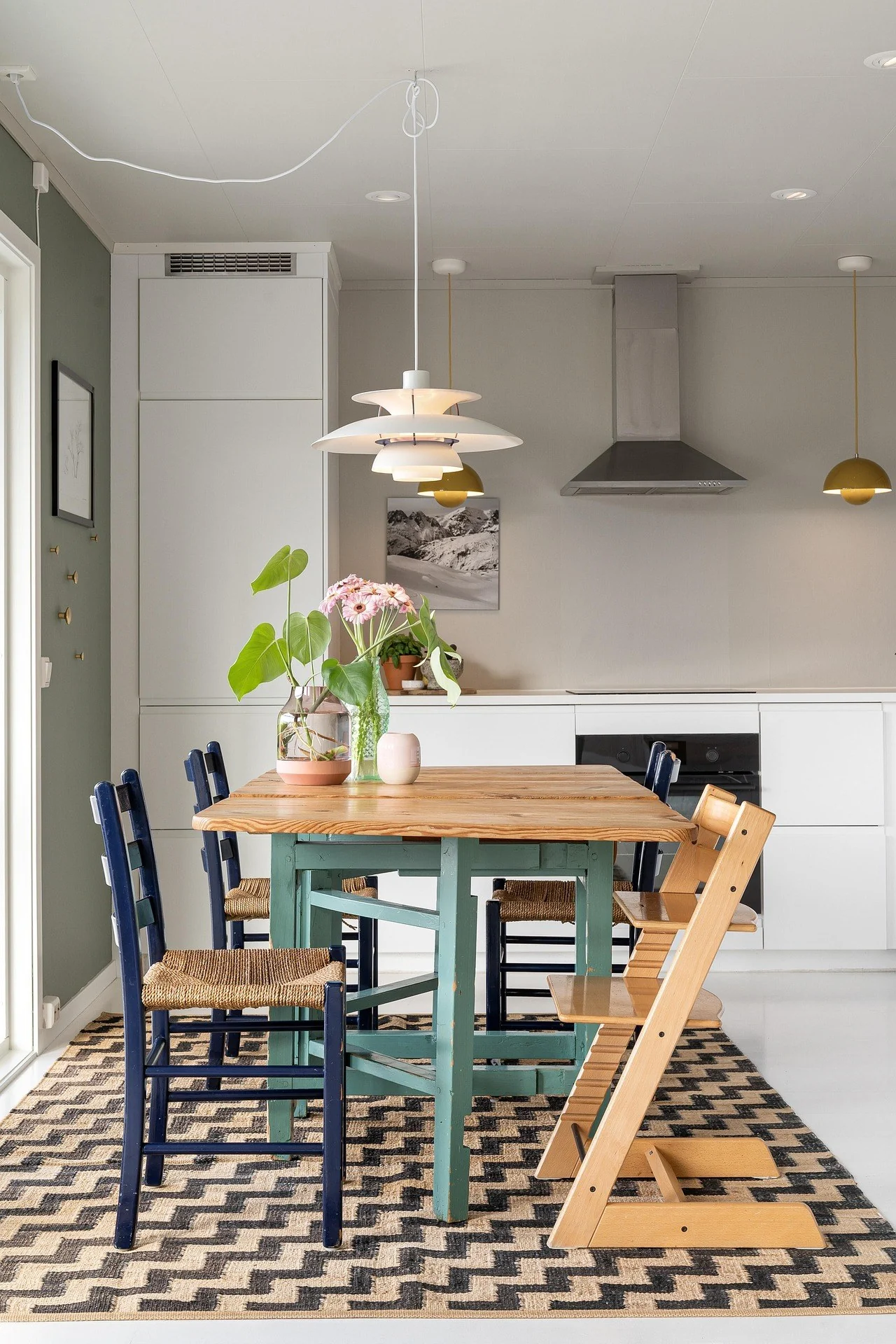
Give a breakfast nook a repeating diamond pattern
The rug beneath a table has a different footprint from a runner in front of the sink. It has to cope with people sitting down, pulling back, and standing up. Think of the chairs in motion, not only the tidy photograph of them tucked under the table.
A diamond-patterned rug beneath a small wood table with a green base and blue chairs turns this breakfast corner into a distinct group. The pattern is graphic, but its repeated diamonds are easy to read at this modest scale. It doesn’t need to stretch toward the kitchen sink to make an impact.
This works well in an apartment or small eat-in room where breakfast happens in one dedicated spot. Watch the chair legs: a too-small rug that ends beneath a tucked-in chair can catch as soon as someone scoots back. If there is not enough room to enlarge the rug, an uncovered floor may be the cleaner decision. The goal is a usable nook, not a patterned border that keeps snagging the furniture.
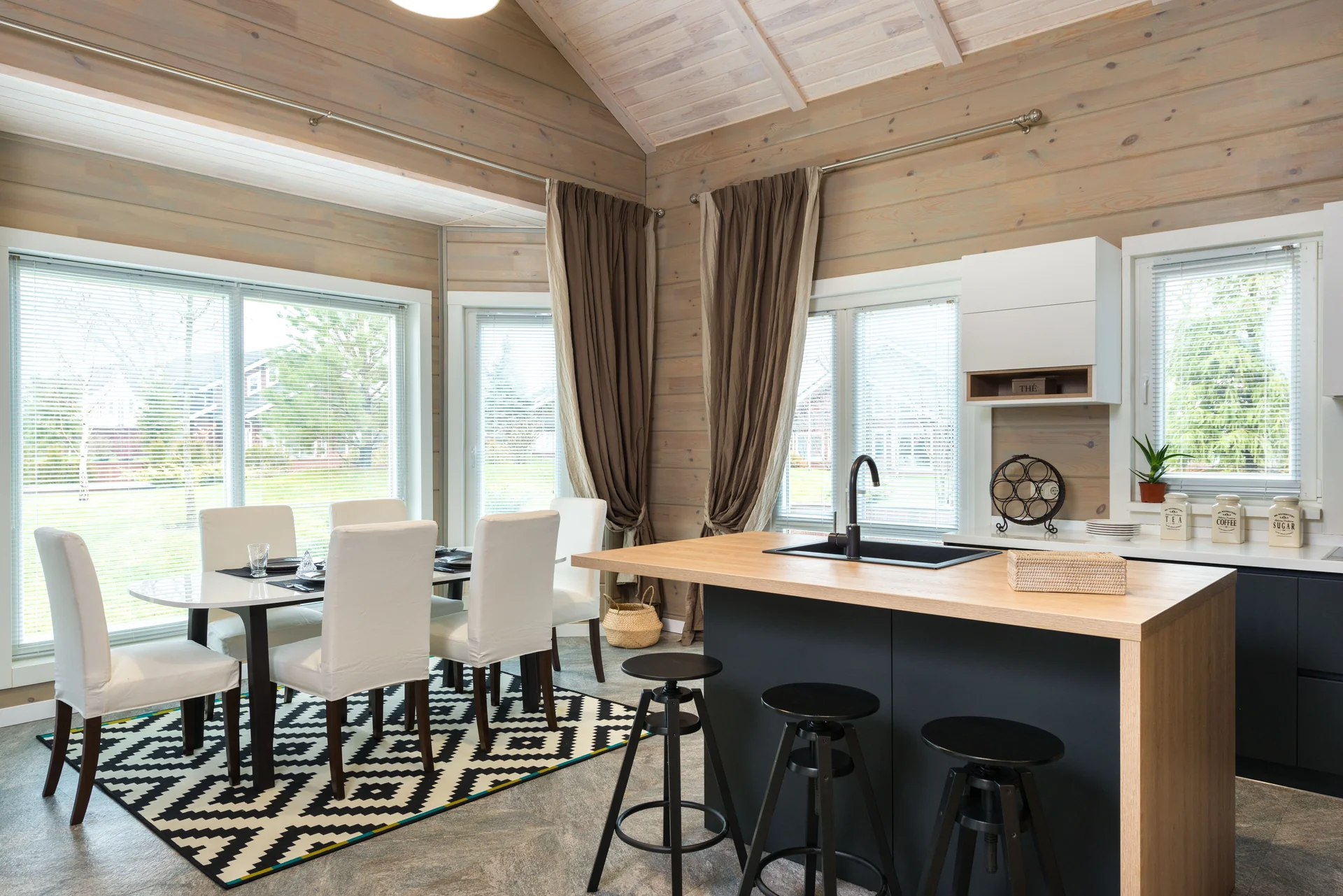
Make one bold geometric rug the main pattern
The black-and-white rug in this open kitchen is deliberately assertive. Its angular pattern sits beneath a dark rectangular dining table and white slipcovered chairs. The large graphic shapes give the pale seating area a strong base against the gray floor.
A graphic rug works best when the rest of the room is visually restrained. If your backsplash is already busy or your counters are crowded with small objects, a quieter pattern may balance better. Notice where this rug sits: under the dining furniture, not where a cook stands at a wet sink. How much contrast to use is a style choice; chair clearance and cleanability are practical ones.